A Hidden Pattern Inside a Familiar Sequence
Quanta-style accessible introduction to the orbit structure of digital-root Fibonacci sequences for non-specialist readers.
Abstract
An accessible companion to the canonical math paper: how the digital root of the Fibonacci sequence loops every 24 numbers, and what hidden structure that loop contains. Written for readers without a mathematical background.
Submission targets
- Magazine / Quanta-style outlet·journalDraft
A Hidden Pattern Inside a Familiar Sequence
Popular-audience version of papers/math/canonical.md. Written for readers without specific mathematical training. Intended as a Quanta-style article or magazine piece. ~3,000 words.
The setup
Take any two whole numbers: let's say 1 and 1. Add them together: you get 2. Now add the last two numbers in your list: 1 + 2 = 3. Then again: 2 + 3 = 5. And again: 3 + 5 = 8. Keep going. You'll get 13, 21, 34, 55, 89, and so on, growing forever.
This is the Fibonacci sequence: probably the most famous sequence in mathematics. It shows up in sunflower seed spirals, pinecone scales, the arms of nautilus shells, and anywhere else where things grow under angular constraints. The ratio between consecutive Fibonacci numbers approaches the golden ratio, ~1.618, which is itself one of the most studied constants in art, biology, and design.
So far, nothing surprising. But there's a transformation you can apply to the sequence, one that's so simple it feels like cheating, but that reveals an entire hidden structure most people never see. It's called the digital root.
To compute the digital root of a number, you just add up its digits. If the result is more than 9, you add the digits of the result. You keep doing this until you have a single digit between 1 and 9. So:
- digital root of 13 = 1 + 3 = 4
- digital root of 89 = 8 + 9 = 17 → 1 + 7 = 8
- digital root of 144 = 1 + 4 + 4 = 9
Here's what happens when you apply the digital root to each Fibonacci number in turn:
Fibonacci:    1, 1, 2, 3, 5, 8, 13, 21, 34, 55, 89, 144, 233, 377, 610, 987, …
Digital root: 1, 1, 2, 3, 5, 8,  4,  3,  7,  1,  8,   9,   8,   8,   7,   6, …
Every Fibonacci number, no matter how huge, collapses to a single digit. And the resulting sequence of single digits, what does it do?
It loops.
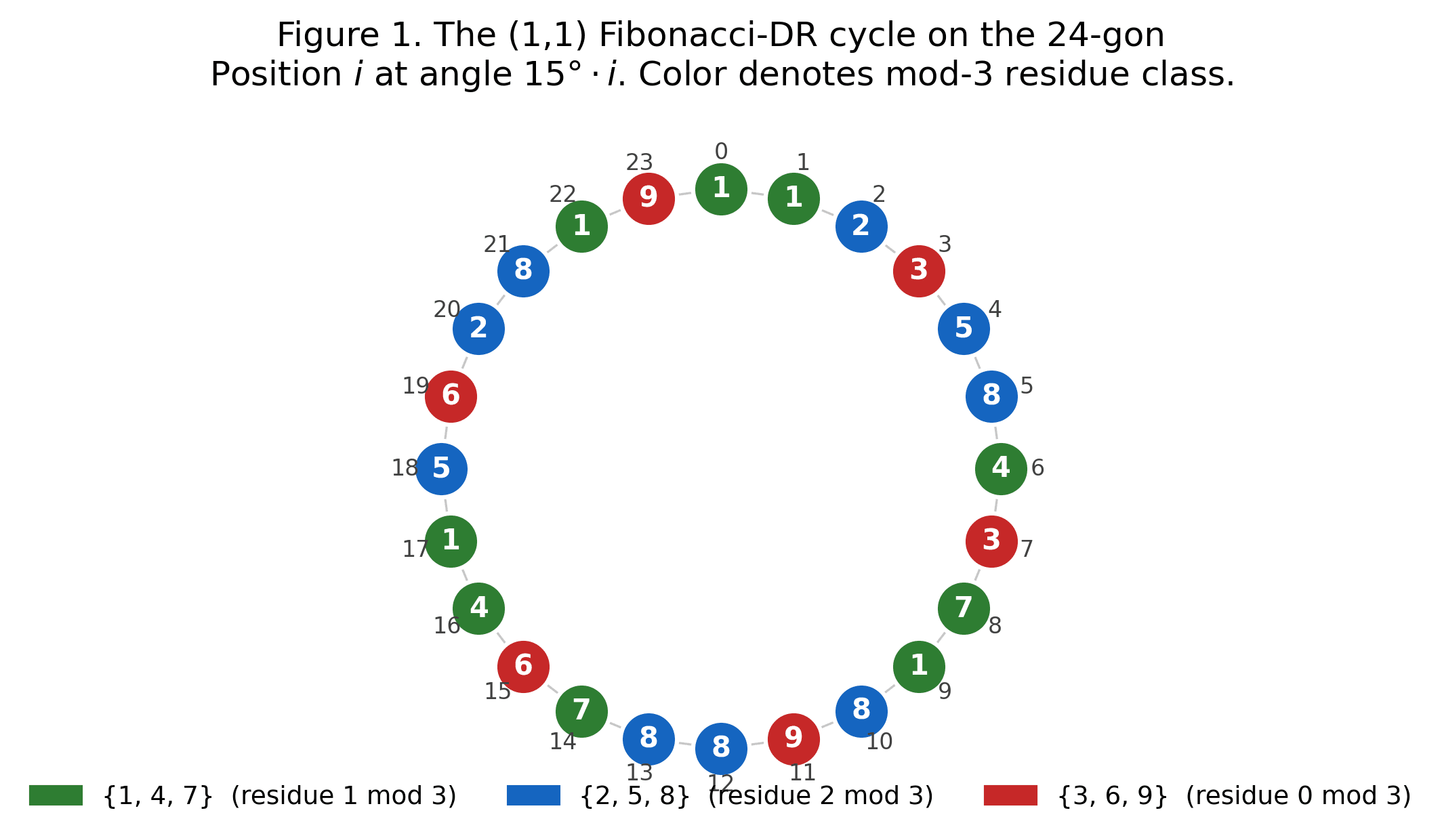
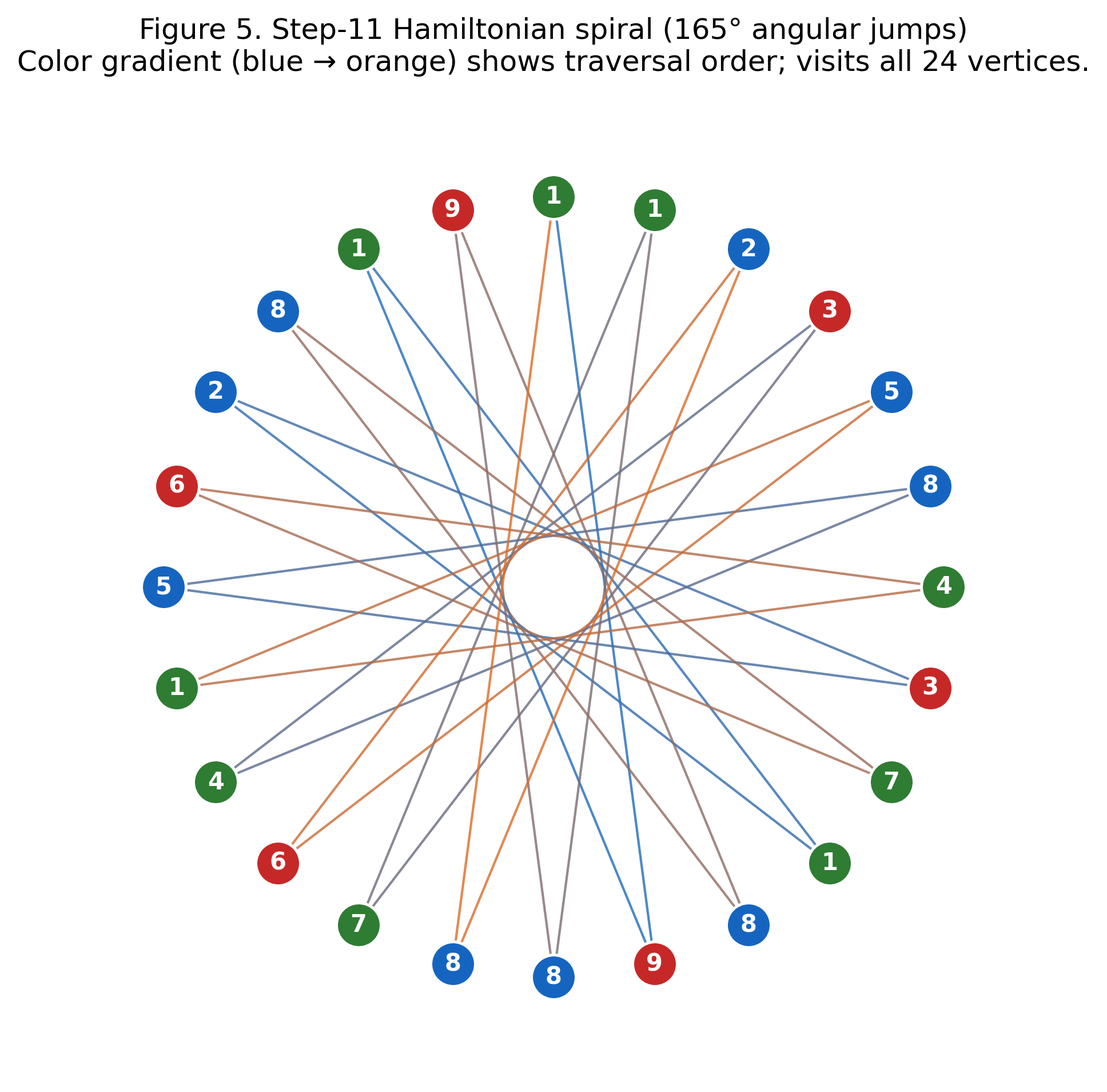
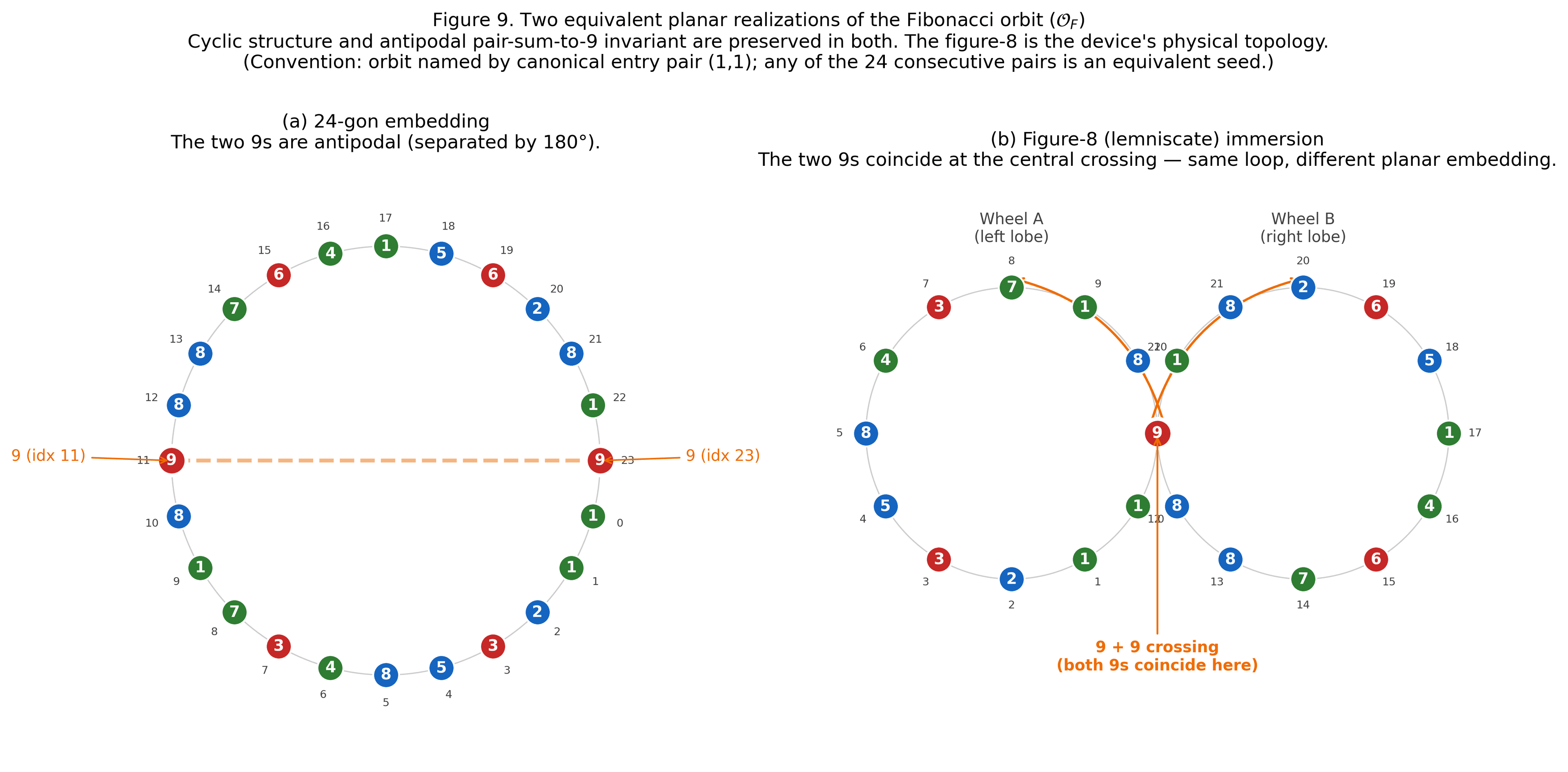
After exactly 24 terms, the pattern starts over. Forever. The numbers [1, 1, 2, 3, 5, 8, 4, 3, 7, 1, 8, 9, 8, 8, 7, 6, 4, 1, 5, 6, 2, 8, 1, 9] repeat indefinitely as you keep computing.
This is called the Pisano period of Fibonacci modulo 9, and the fact that it equals 24 has been known since at least 1960 (in this specific form; the more general theory is much older). What hasn't been widely documented is the structure hiding inside that 24-element cycle, and that structure turns out to be unexpectedly rich.
What's hiding in 24 numbers
Let's stare at the cycle for a moment:
1, 1, 2, 3, 5, 8, 4, 3, 7, 1, 8, 9, 8, 8, 7, 6, 4, 1, 5, 6, 2, 8, 1, 9
Pick any two adjacent numbers (say the 5 and the 8) and use them as the starting pair for a fresh Fibonacci-with-digital-root sequence. What do you get?
5, 8, 13→4, 12→3, 7, 10→1, 8, 9, 8+9=17→8, 8, 7, 6, 4, 1, 5, 6, 2, 8, 1, 9, 1, 1, 2, 3
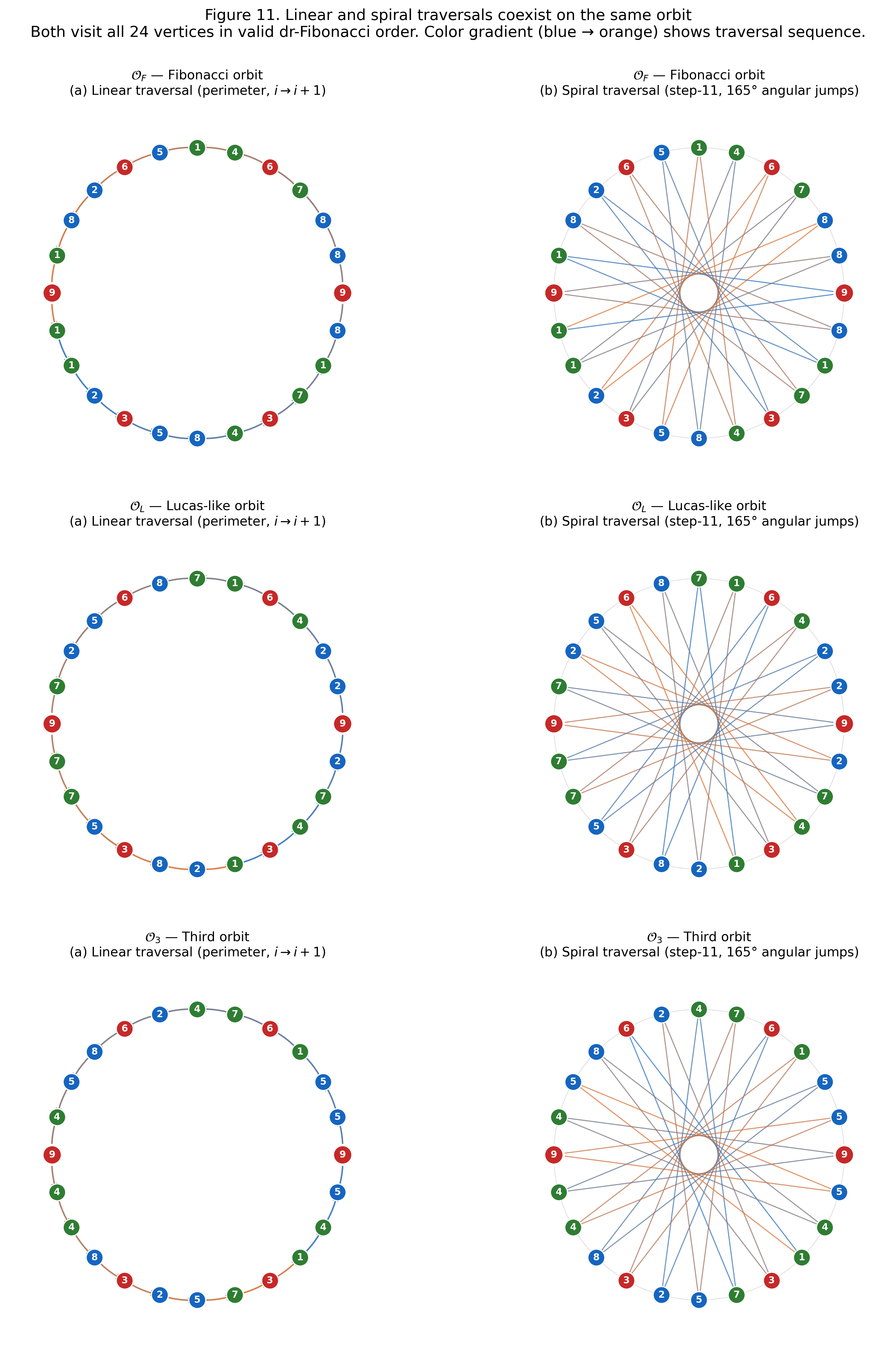
The same 24 numbers, just rotated to start at a different point. Pick a different adjacent pair. Same result. The cycle is one closed loop, and you can enter it anywhere; you'll always trace out the same orbit.
That's the first hidden property: every point inside the cycle is both a beginning and an end. There's no privileged starting position. The sequence isn't a list with a first and last element; it's a circle, and the (1, 1) seed is just a human convenience.
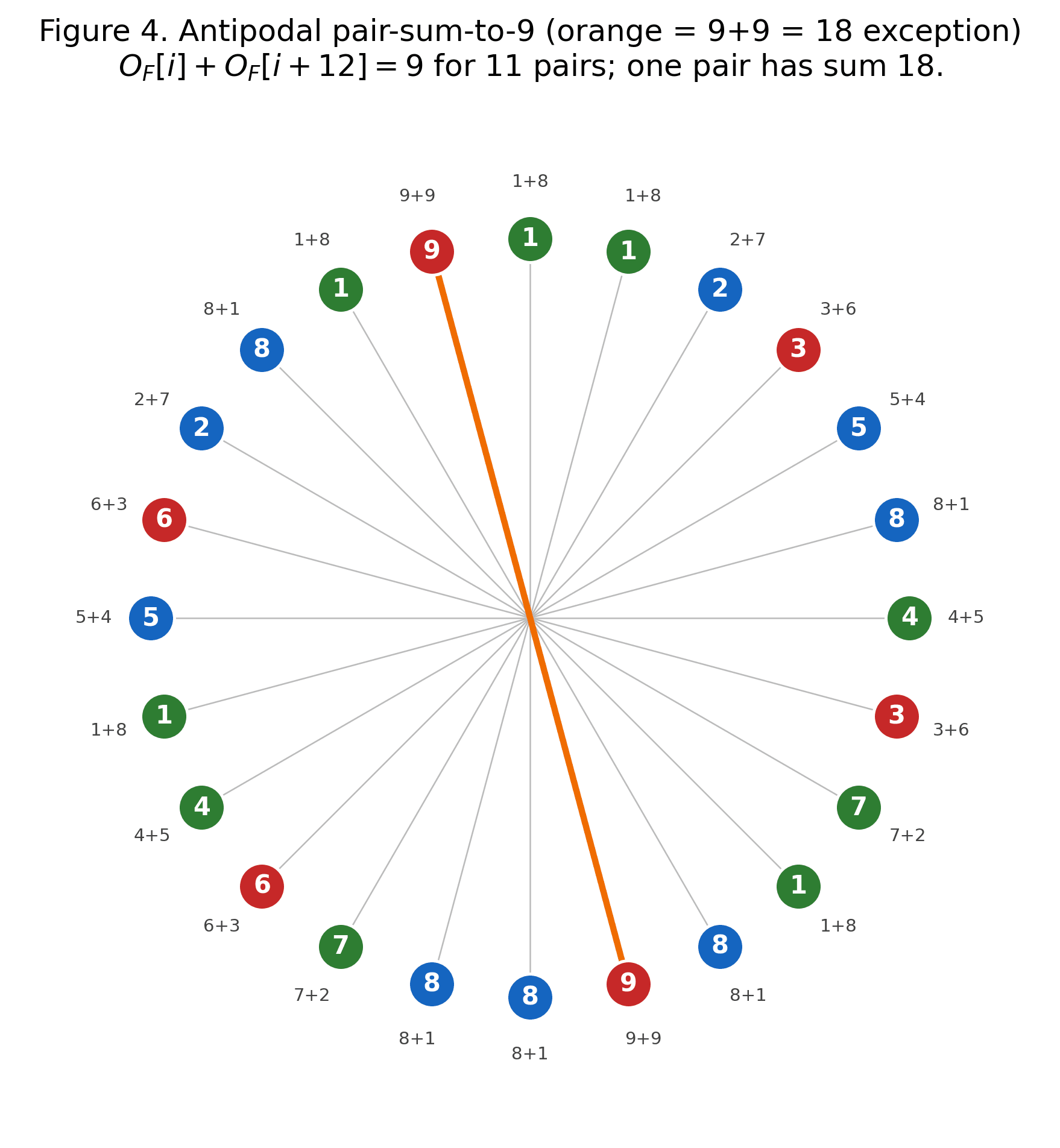
Next: try this. Compare each number in the first half of the cycle with the number 12 positions later (the "antipodal" position):
Position:  1   2   3   4   5   6   7   8   9   10  11  12
First 12:  1,  1,  2,  3,  5,  8,  4,  3,  7,  1,  8,  9
Last  12:  8,  8,  7,  6,  4,  1,  5,  6,  2,  8,  1,  9
Sum:       9,  9,  9,  9,  9,  9,  9,  9,  9,  9,  9, 18
Eleven of the twelve antipodal pairs sum to 9. The twelfth (where both halves happen to be 9) sums to 18.
This isn't an accident. It comes from a deep property of Fibonacci numbers: the half-period of the Pisano cycle is its own negation. In the digital root world, "the negative of x" is "9 minus x" (because 9 is the same as 0 in modular arithmetic), so antipodal positions cancel each other out, except where the value is itself 9, which has no nonzero pair.
This means the cycle has a perfect mirror symmetry around its diameter, with one asymmetric "broken mirror" where 9 reflects to 9 instead of 0. Mathematicians call this an involution; it's the same kind of structure that shows up in the way complementary angles add to 90° or supplementary angles to 180°. (In fact, both of those are consequences of exactly the same fact: the number 9 divides 90 and 180.)
The hexagon hiding in plain sight
Look at where the 3s, 6s, and 9s appear in the cycle:
Index:   0  1  2  3  4  5  6  7  8  9  10 11 12 13 14 15 16 17 18 19 20 21 22 23
Value:   1  1  2  3  5  8  4  3  7  1  8  9  8  8  7  6  4  1  5  6  2  8  1  9
                  ↑        ↑           ↑           ↑           ↑           ↑
                 (3)      (3)         (9)         (6)         (6)         (9)
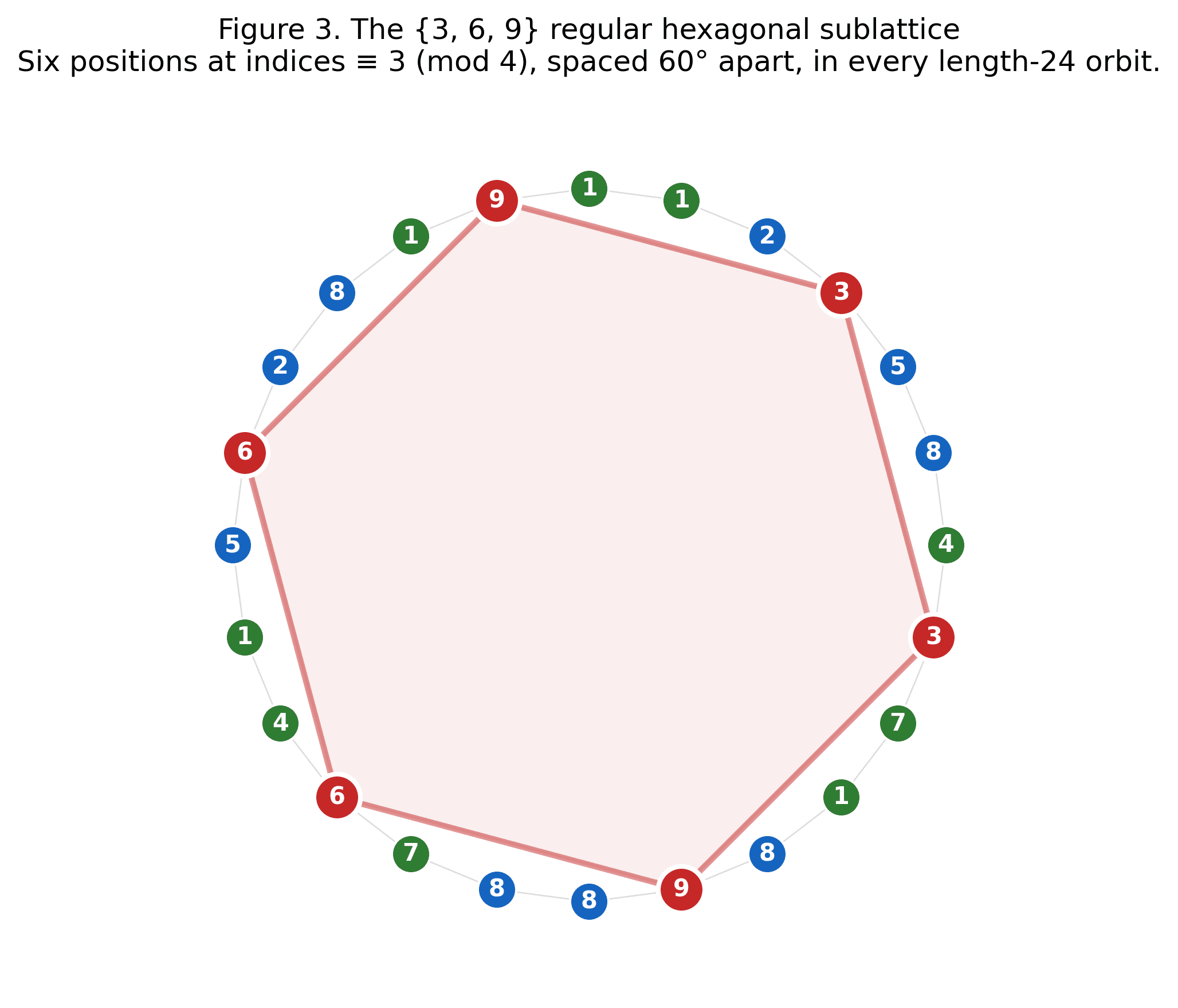
They appear at positions 3, 7, 11, 15, 19, and 23, exactly 4 positions apart, six times around the cycle.
If you draw the 24 positions as the vertices of a 24-sided polygon (with 15 degrees between vertices), the six positions holding {3, 6, 9} form a regular hexagon at 60-degree spacing. They're a perfect six-pointed structural skeleton inside the 24-element cycle.
Why? Because the Fibonacci sequence reduced modulo 3 has period 8, with zero appearing every 4 indices. So multiples of 3 (which become 3, 6, or 9 when we apply digital root) appear at every fourth position in the Pisano-24 cycle, six times total, evenly spaced.
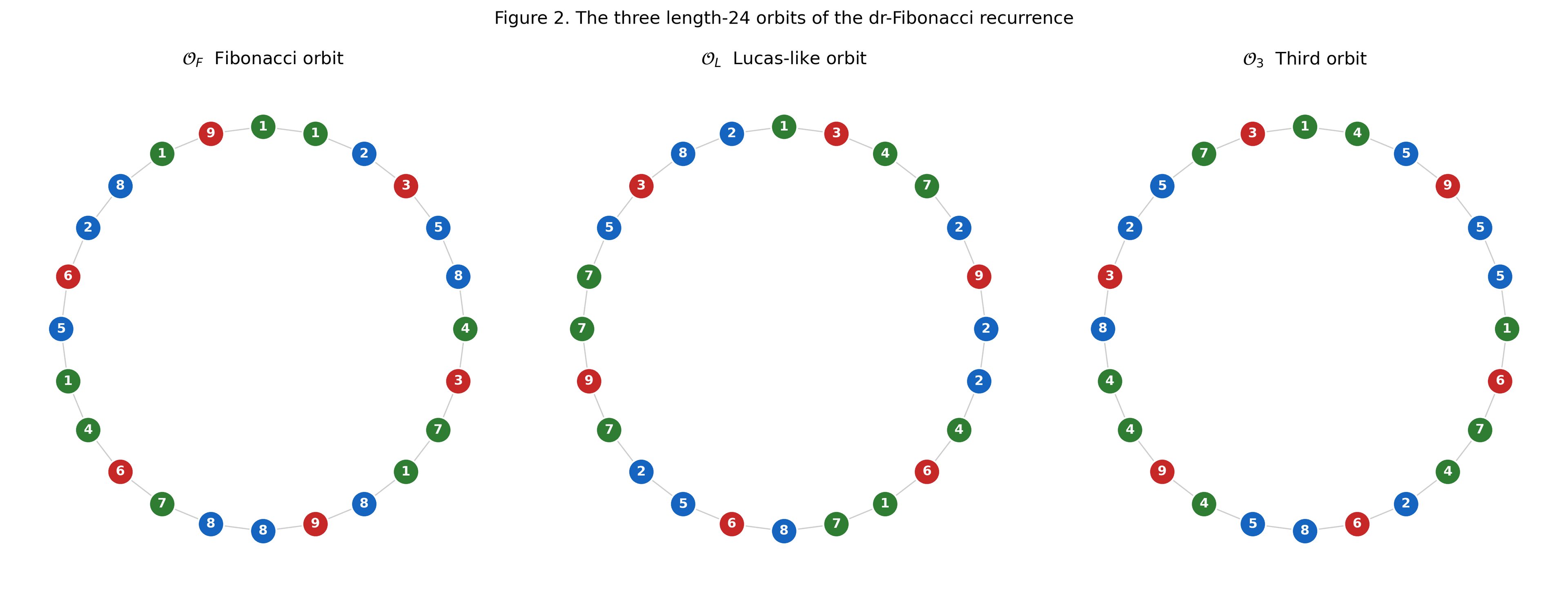
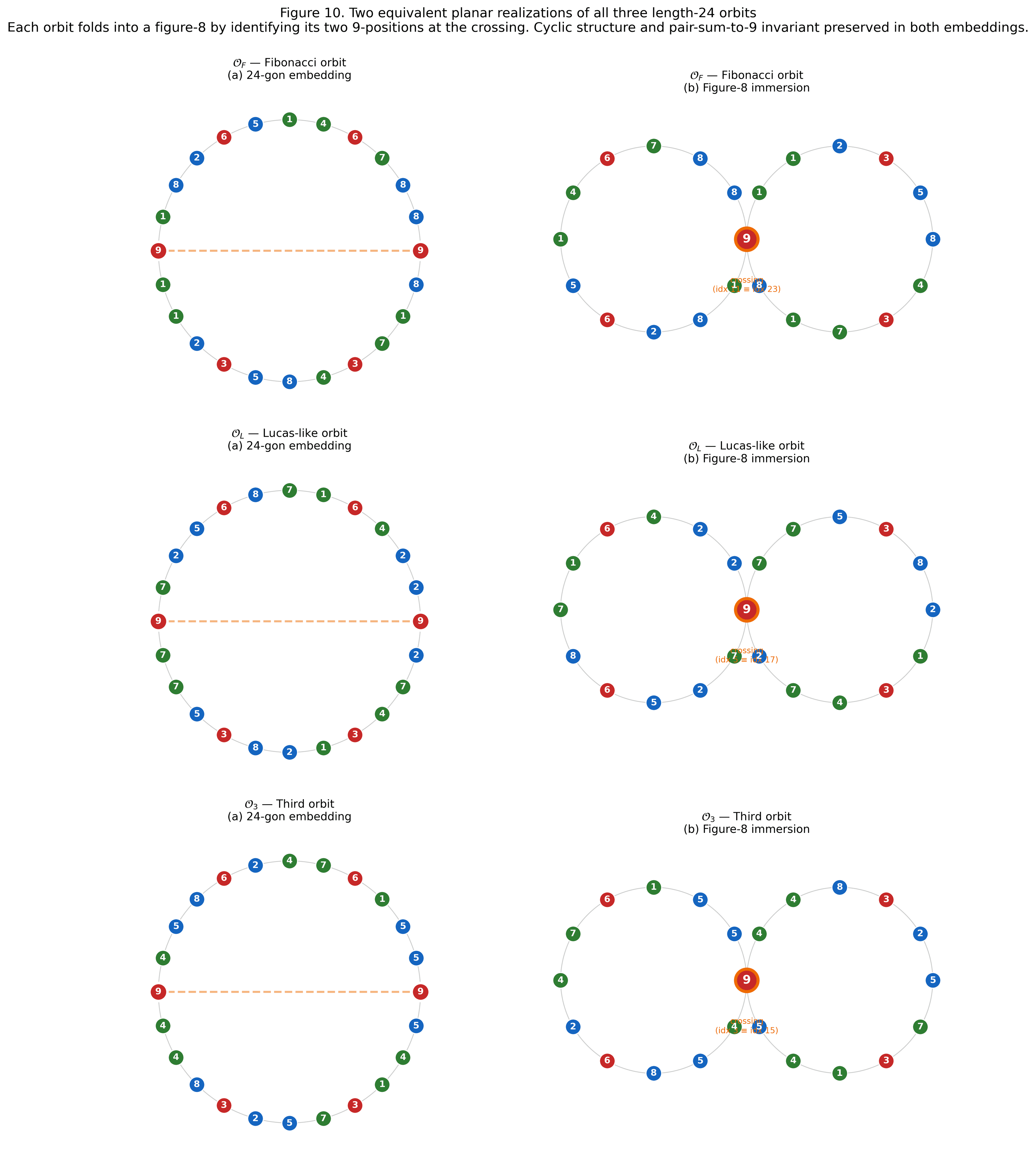
This hexagon isn't unique to the (1, 1) Fibonacci sequence. The same regular six-vertex skeleton appears in any sequence built from the same recurrence with different starting numbers: three different valid sequences exist, and all three have a {3, 6, 9} hexagon at six evenly-spaced positions.
The hexagon makes the cycle naturally compatible with triangles and hexagonal tilings: if you want to inscribe a triangle whose three vertices all carry {3, 6, 9} values, you can: pick any three alternating hexagon vertices. Same for a Star of David (the hexagon split into two overlapping triangles). What you cannot do is inscribe a square or pentagon or octagon with all vertices on {3, 6, 9}, because those polygons need vertex counts that don't divide evenly into the 6-point hexagonal skeleton.
So the cycle has a built-in family of natural inscribed shapes (triangle, hexagon, hexagram) but resists others. The math is preserving symmetries it has, and refusing symmetries it doesn't.
Three sequences, exhaustively
So far we've talked about one specific Fibonacci-digital-root sequence: the one starting with (1, 1). Are there others?
Yes, and exactly three.
If you take any pair of starting numbers (a, b) and run the recurrence, the resulting 24-cycle ends up being one of three possibilities (or, in special cases, a much smaller cycle on the digits {3, 6, 9}). The three are:
| Seed | The 24-cycle it generates |
|---|---|
| (1, 1) | 1, 1, 2, 3, 5, 8, 4, 3, 7, 1, 8, 9, 8, 8, 7, 6, 4, 1, 5, 6, 2, 8, 1, 9 |
| (1, 3) | 1, 3, 4, 7, 2, 9, 2, 2, 4, 6, 1, 7, 8, 6, 5, 2, 7, 9, 7, 7, 5, 3, 8, 2 |
| (1, 4) | 1, 4, 5, 9, 5, 5, 1, 6, 7, 4, 2, 6, 8, 5, 4, 9, 4, 4, 8, 3, 2, 5, 7, 3 |
If you pick any pair of starting positive integers and run the recurrence on their digital roots, you'll land in one of these three cycles, or, if both your starting digits happen to be 3, 6, or 9, in the small "binding" cycle that uses only those three digits and never escapes into the others. There are no other possibilities. It's been verified exhaustively over all 81 pairs of single-digit starting values.
Take a moment to sit with that. Pick two random integers (5,376 and 88,891) apply the digital roots (which are 3 and 7), and you'll trace out one of the three 24-cycles. Pick two billion-digit numbers; same result. The function deterministically partitions every starting pair in the universe into one of three orbits (or one of two small special-case orbits). Nothing escapes.
This is what mathematicians mean when they say a sequence has exhaustive orbital structure. It's not three among many; it's the three.
The hidden multiplication
Here's where it gets interesting. The Fibonacci sequence is built from addition, you add the previous two terms. But hidden inside the 24-cycle is a totally different mathematical operation: multiplication by 2.
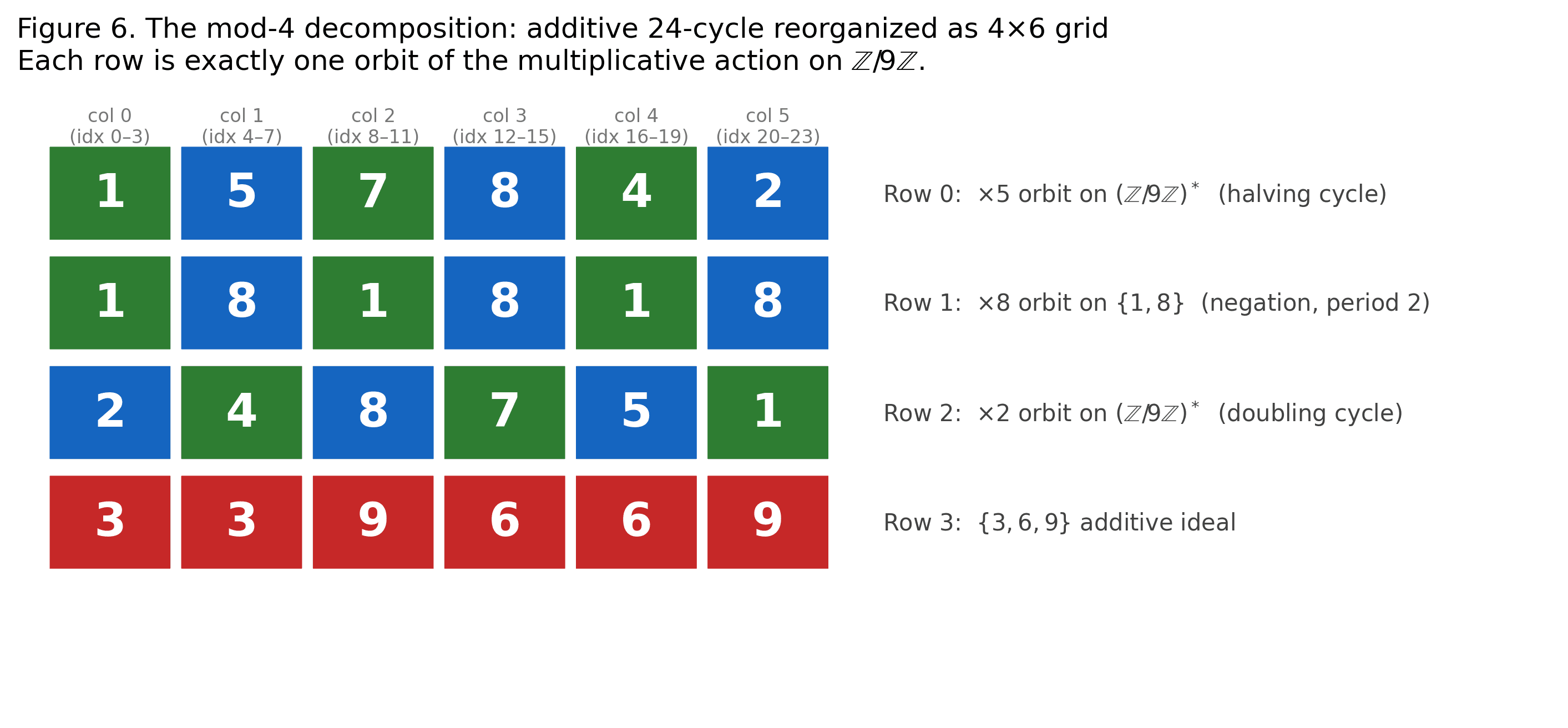
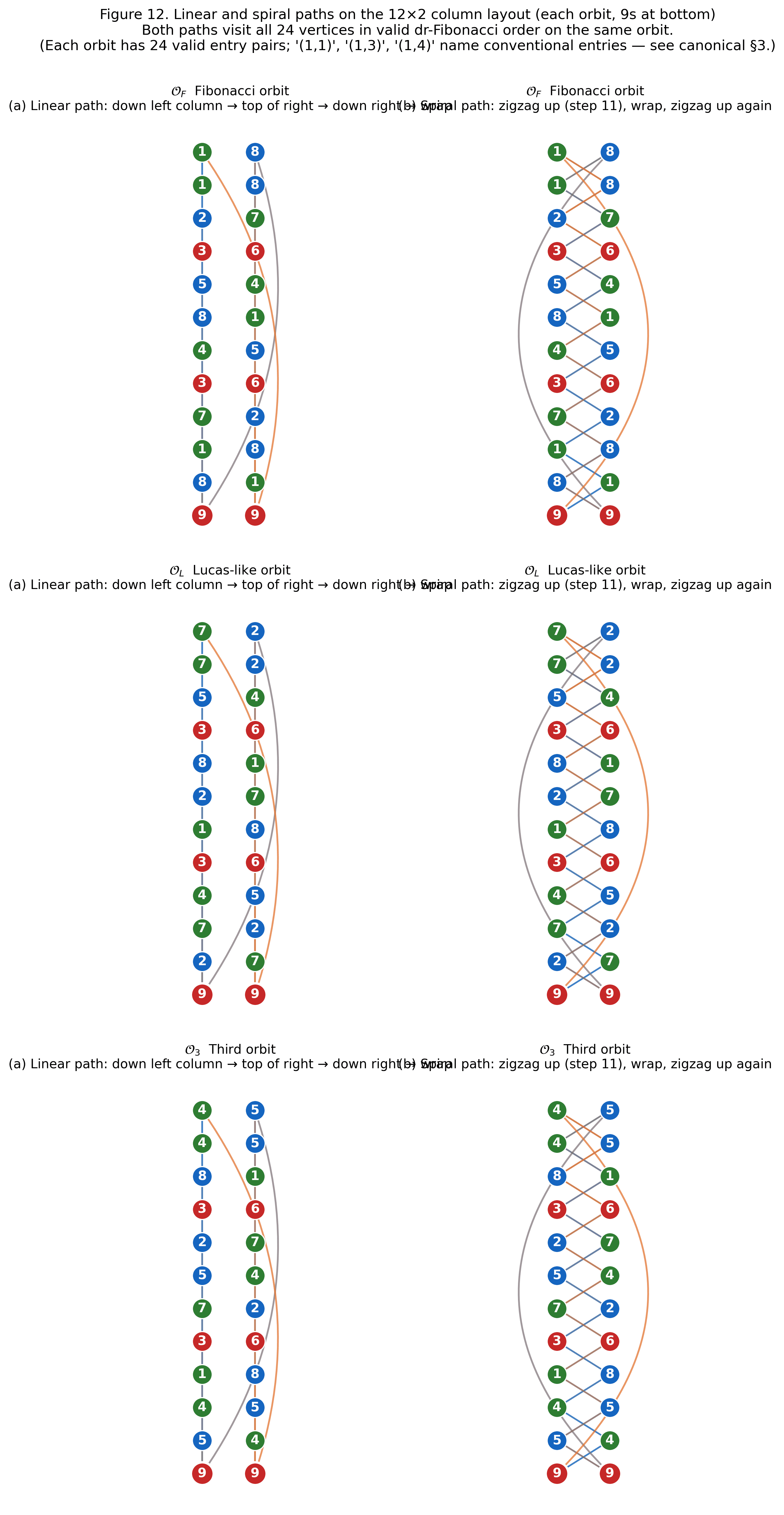
If you take the cycle and split it into a 4-by-6 grid (4 rows, 6 columns, filled column by column), four distinct things appear in the four rows:
Row 0:  1  5  7  8  4  2     ← multiplication by 5 (= 1/2 mod 9, the doubling cycle backwards)
Row 1:  1  8  1  8  1  8     ← multiplication by 8 (= -1 mod 9, the negation cycle)
Row 2:  2  4  8  7  5  1     ← multiplication by 2 (the doubling cycle forwards)
Row 3:  3  3  9  6  6  9     ← the {3, 6, 9} family (the additive island)
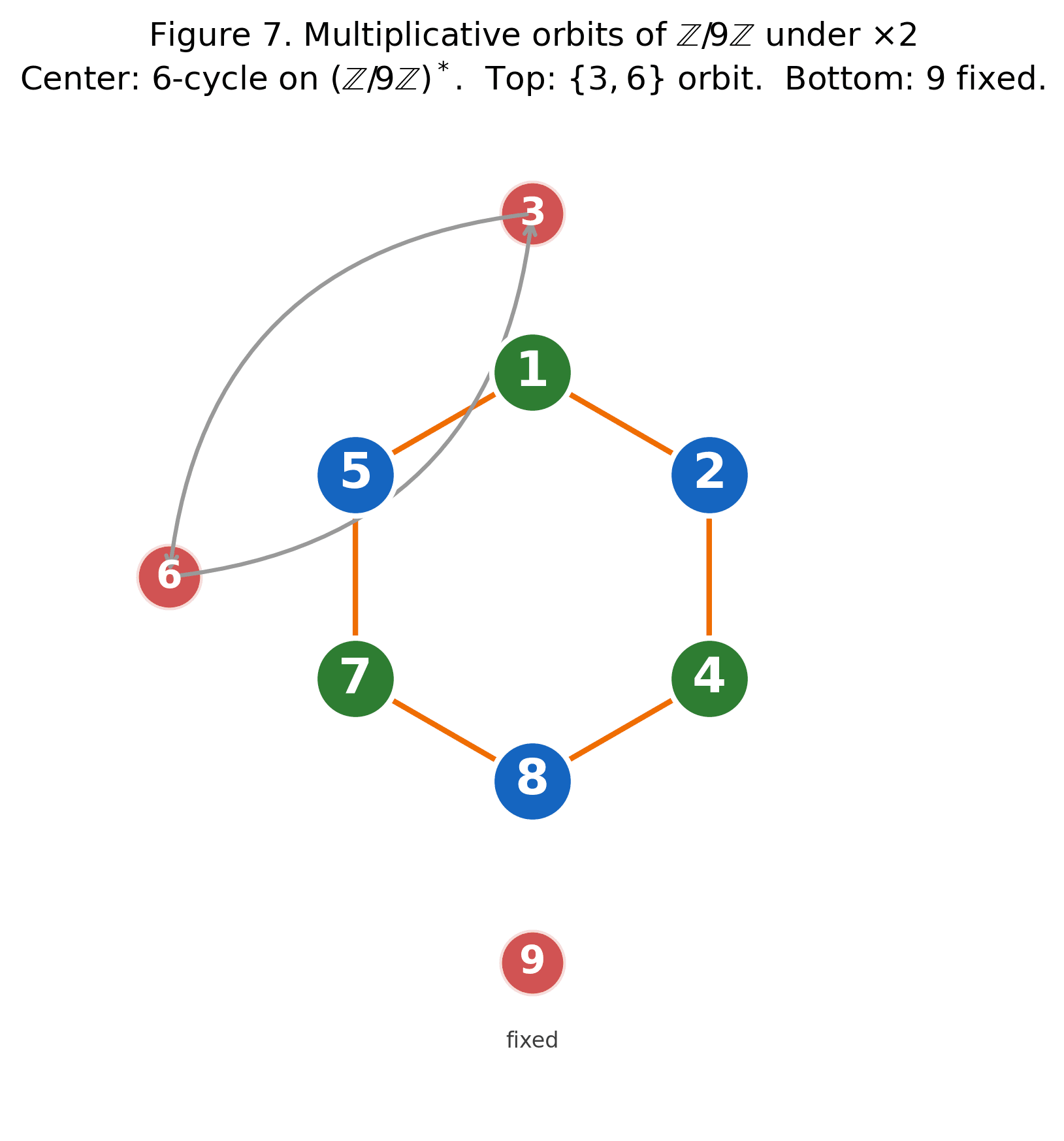
Two of those rows (0 and 2) are the doubling sequence: starting from 1, multiply by 2 repeatedly mod 9. You get 1 → 2 → 4 → 8 → 7 → 5 → 1. Six numbers, then back to the start. (Doubling 8 mod 9 gives 16, which is 7 in mod-9 arithmetic; doubling 7 gives 14, which is 5; doubling 5 gives 10, which is 1.)
Row 0 is the same orbit going backwards, multiplying by 5 instead of 2 gives the same numbers in reverse. (5 is the multiplicative inverse of 2 mod 9.)
Row 1 alternates 1 and 8 because doubling them mod 9 produces a 2-cycle (1 ↔ 8 under multiplication by -1).
Row 3 is the {3, 6, 9} hexagon family we already met, closed under both addition and multiplication, an algebraic island.
This is the central new insight of the math paper: the additive structure of Fibonacci-with-digital-root and the multiplicative structure of the integers mod 9 are the same algebraic object viewed in two different coordinate systems. The mod-4 grid is the explicit translation between them.
You wouldn't expect this. Addition and multiplication are different operations. But somehow, the way Fibonacci numbers reduce mod 9 encodes the multiplicative orbits as residues of the additive orbit. The two structures are interlocked.
Why the number 24
Take a step back. The number 24 keeps showing up. It's the period of the cycle. It's the number of elements you decompose into 4 rows. It's the "grid frame."
Here's another place 24 shows up, and it's surprising.
Consider the prime numbers: 2, 3, 5, 7, 11, 13, 17, 19, 23, 29, 31, 37, …
Now look at what those primes are when you reduce them modulo 24 (i.e., their remainders when divided by 24):
- 2 mod 24 = 2
- 3 mod 24 = 3
- 5 mod 24 = 5
- 7 mod 24 = 7
- 11 mod 24 = 11
- 13 mod 24 = 13
- 17 mod 24 = 17
- 19 mod 24 = 19
- 23 mod 24 = 23
- 29 mod 24 = 5
- 31 mod 24 = 7
- 37 mod 24 = 13
- ...
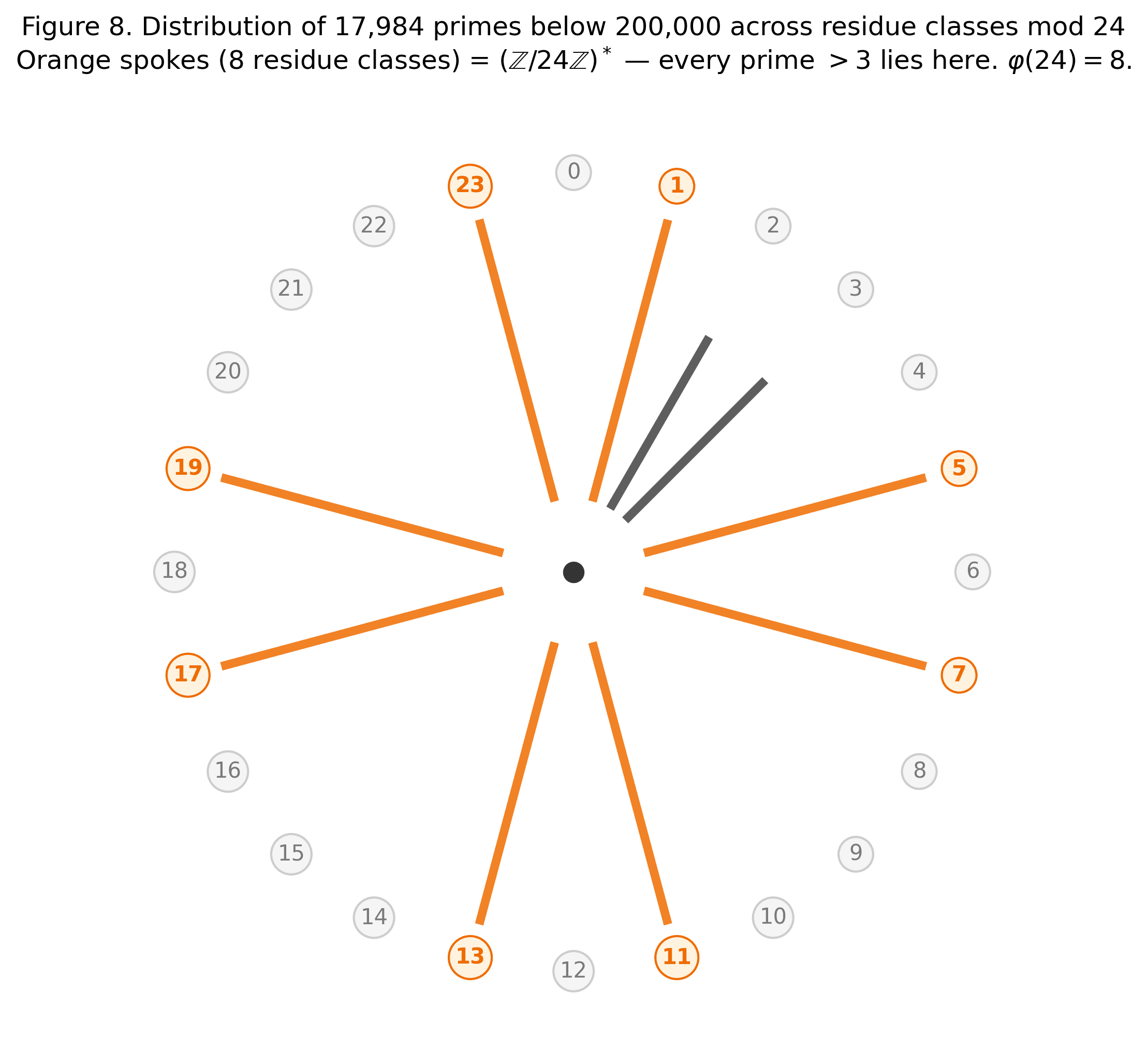
If you sweep through all primes below, say, 200,000 and tally which residue classes mod 24 they land in, you find: every prime greater than 3 lands in one of exactly 8 residue classes: namely {1, 5, 7, 11, 13, 17, 19, 23}. The other 16 residue classes don't contain any primes greater than 3.
This isn't a curiosity; it's a theorem. A prime greater than 3 has to be coprime to 24 (since 24 = 8 × 3), and the residues coprime to 24 are exactly those 8. The number of them (8) is given by Euler's totient function φ(24).
Notice the convergence: 24 is the Pisano period of Fibonacci mod 9, and 24 is the integer whose totient organizes prime distribution. Both facts come from the prime factorization 24 = 2³ × 3. The same number is doing structural work in two seemingly unrelated places.
This is not a deep prediction about prime distribution. The classical result on primes mod 24 is unaffected by anything in the new paper. What the paper observes is a structural unification: the same algebraic frame organizes the additive Fibonacci structure and the multiplicative coprimality structure of the integers, because they both arise from properties of the prime factorization of 24.
Why this matters (and why it doesn't)
So what?
Mathematically, there's a beautiful piece of structure here that hasn't been documented in this specific form. The mod-4 decomposition (the additive cycle revealing the multiplicative orbits) is genuinely new (to my and the paper's authors' knowledge). It's an explicit isomorphism between two pieces of algebraic structure that look unrelated until you reorganize the data.
Practically, the paper points to a physical realization: a mechanical device called the Infinity Wheel that uses this 24-cycle as the design rule for an asymmetric weight distribution on coupled wheels. That's described in a separate companion paper. It's a coupled-oscillator demonstration in the lineage of overbalanced wheels going back to Bhāskara II in the 12th century, not perpetual motion (no such thing), but a clean, mathematically derived realization of a class of devices that have fascinated tinkerers and mathematicians for centuries.
What the paper is not claiming is that the Fibonacci-digital-root structure underlies physics, or cognition, or reality. It's a piece of mathematics with elegant internal structure and one nice physical realization. That's enough.
The deeper lesson (if there is one) is the same lesson math keeps teaching: simple rules produce surprising structure, and the structure is often visible only when you reorganize what you're looking at. A 24-element cycle written linearly looks like just numbers. The same cycle laid out as a 4×6 grid reveals the multiplicative group of Z/9Z. The same cycle laid out on a circle reveals a hexagonal sublattice. The same cycle laid out as columns reveals an angle-arithmetic mirror.
The mathematics didn't change. Your viewing angle did.
Where to go next
If this whetted your curiosity:
-
The full paper.
papers/math/canonical.mdin the project repository has the proofs, the figures, and the references. It's written for readers comfortable with undergraduate-level abstract algebra (groups, rings, ideals). -
The OEIS. The On-Line Encyclopedia of Integer Sequences (oeis.org) is the place to look up any integer sequence and find what's known about it. Pisano periods are A001175.
-
Phyllotaxis. The most well-documented physical appearance of Fibonacci sequences in the natural world is in plant growth: leaves, sunflower seeds, pinecone scales. The papers by Mitchison (1977) and Douady & Couder (1992) are the standard references.
-
Coupled oscillators and synchronization. Pikovsky, Rosenblum, and Kurths' textbook Synchronization is the standard reference. The Wikipedia page on Huygens' 1665 coupled-pendulum observation is a short, accessible entry point.
-
The Infinity Wheel device.
papers/device/canonical.mdin the project repository describes the mechanical design that uses this math.
Figures
Reference figures from the paper. Sources reproducible from the paper's figures directory.
Related papers
Source-of-truth: infinity-wheel/papers/math/popular/article.md