Orbital and Multiplicative Structure of Digital-Root Fibonacci Sequences
Five-orbit decomposition of the digital-root Fibonacci recurrence on Z/9Z, with a mod-4 reorganization that exposes the multiplicative structure of (Z/9Z)*.
Abstract
We study the orbit structure of the digital-root Fibonacci recurrence xₙ = dr(xₙ₋₁ + xₙ₋₂) on positive integer pairs, where dr is the base-10 digital root (reduction modulo 9 with 0 ↔ 9). The recurrence has Pisano period 24 and partitions starting pairs into exactly five orbits: three Hamiltonian length-24 cycles, one length-8 cycle, and the fixed point (9, 9). The central new result is the mod-4 decomposition: reorganizing the 24-cycle by index modulo 4 yields four subsequences that are exactly the four orbits of the multiplicative monoid action on Z/9Z.
Submission targets
- arXiv (math.NT)·journalDraft
- Fibonacci Quarterly·journalDraft
Orbital and Multiplicative Structure of Digital-Root Fibonacci Sequences
Canonical master draft. Target audience: arXiv-grade mathematical rigor. Derivative versions (Fibonacci Quarterly, popular, README, OEIS) derive from this document. Version 0.1, first complete draft.
Abstract
We study the orbit structure of the digital-root Fibonacci recurrence xₙ = dr(xₙ₋₁ + xₙ₋₂) on positive integer pairs as initial conditions, where dr denotes the base-10 digital root (equivalently, reduction modulo 9 with 0 ↔ 9 for nonzero classes). The recurrence has Pisano period π(9) = 24 and partitions the space of starting pairs (a, b) ∈ Z₊² into exactly five disjoint orbits: three Hamiltonian cycles of length 24, one cycle of length 8 supported on multiples of 3, and the fixed point (9, 9). The three length-24 orbits exhaust every starting pair (a, b) with at least one of a, b not divisible by 3.
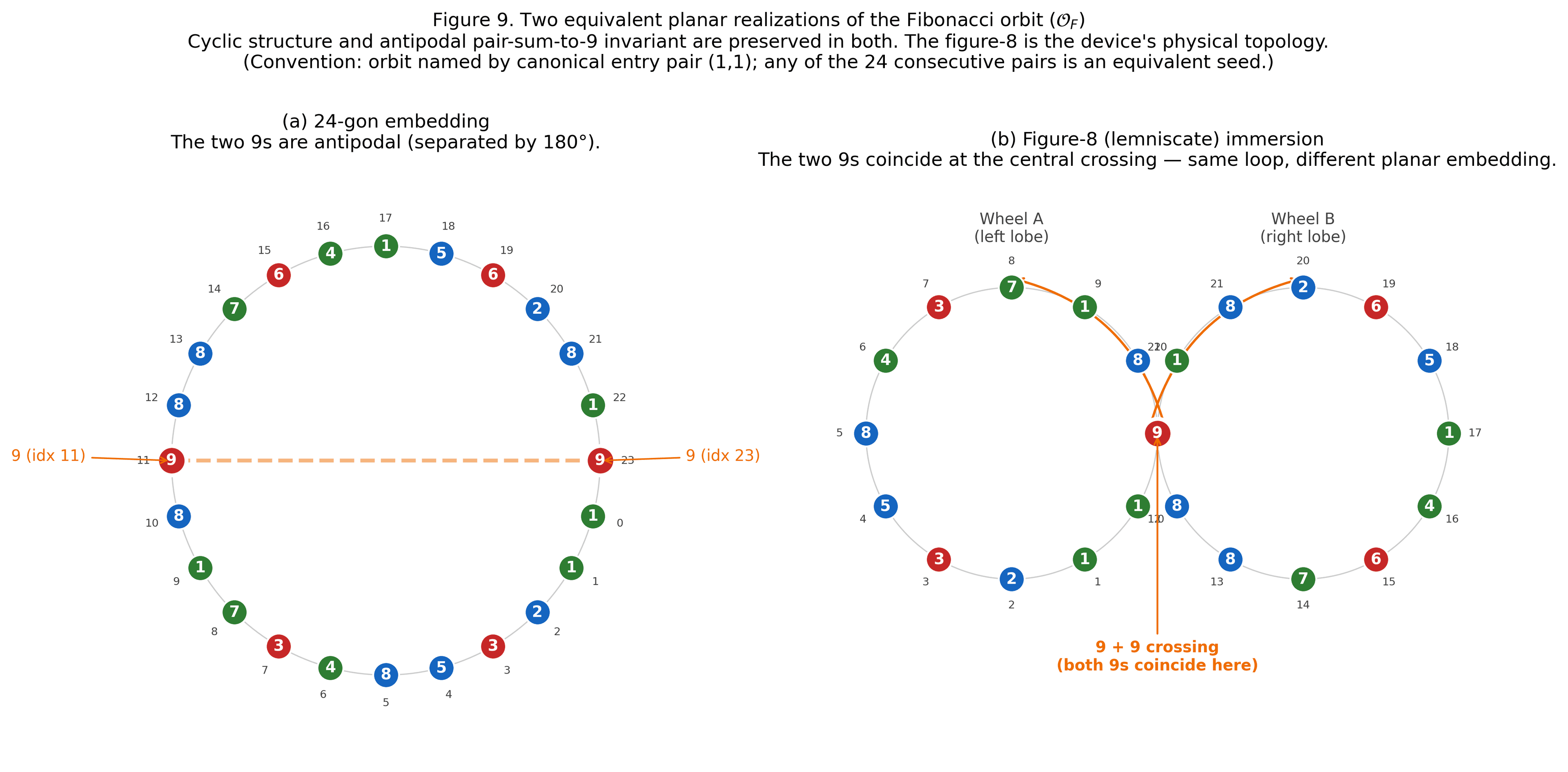
We characterize geometric properties of these length-24 orbits when laid on the regular 24-gon: an antipodal involution (positions i and i + 12 sum to 9 except at one 9 + 9 = 18 antipodal pair), a Hamiltonian step-11 traversal that preserves the dr-Fibonacci recurrence, and a regular hexagonal sublattice of multiples of 3 induced by the period-4 structure of Fibonacci modulo 3. We further note an exact parallel pair-sum-to-9 structure in standard angle arithmetic: for any polygon, the sum of digital roots of interior angles is ≡ 9 (mod 9), because 180 = 9 · 20.
The central new structural result is the mod-4 decomposition: reorganizing the additive 24-cycle by index modulo 4 yields four subsequences, each of which is exactly one of the four orbits of the multiplicative monoid action on Z/9Z: the doubling 6-cycle on (Z/9Z)* in two directions, the negation 2-cycle, and the {3, 6, 9} additive ideal. The additive Fibonacci structure and the multiplicative orbits of Z/9Z are the same algebraic object expressed in two coordinate systems; the mod-4 reorganization is the explicit projection between them.
We close with a structural connection to prime distribution modulo 24: the integer 24, which is π(9), also satisfies φ(24) = 8, and consequently every prime greater than 3 lies in exactly one of (Z/24Z)* = {1, 5, 7, 11, 13, 17, 19, 23}. Both roles arise from the prime factorization 24 = 2³ · 3.
1. Introduction
The Fibonacci sequence F₀ = 0, F₁ = 1, Fₙ₊₁ = Fₙ + Fₙ₋₁ has long been studied for its periodic behavior modulo integers m. The period is the Pisano period π(m), classical results on which date to Wall [Wal60]. The reduction of Fibonacci-type recurrences by digital root (the base-10 cross sum, equivalent to reduction modulo 9 with the nonzero-classes convention dr(9k) = 9) yields a particularly compact periodic structure: π(9) = 24.
This paper studies the orbit structure of the digital-root Fibonacci recurrence
xₙ = dr(xₙ₋₁ + xₙ₋₂), x₁ = a, x₂ = b, a, b ∈ Z₊
as initial conditions vary over Z₊². We establish:
-
(§3) Universal orbit decomposition: every initial pair lies in one of exactly five orbits: three Hamiltonian length-24 cycles, one length-8 cycle on
{3, 6, 9}, and the fixed point(9, 9). -
(§4) A natural
9 + 9 + 6partition of every length-24 cycle by mod-3 cosets ofZ/9Z. -
(§5) Geometric properties of length-24 cycles on the 24-gon: an antipodal
9's-complement involution, a Hamiltonian step-11 spiral that preserves the recurrence, and a regular hexagonal sublattice formed by{3, 6, 9}. -
(§6) The same pair-sum-to-9 structure in standard angle arithmetic, with a one-line proof that polygon interior-angle digital roots always sum to
9 mod 9. -
(§7) The central new structural result: the mod-4 decomposition, which reorganizes the additive 24-cycle to expose all four orbits of the multiplicative monoid action on
Z/9Z. -
(§8) A structural connection to prime distribution modulo 24, via
φ(24) = 8.
The motivation for this study is a separate engineering application, a magnetically-coupled mechanical wheel pair whose mass distribution at 12 angular stations follows the orbit structure described here, treated in a companion paper [in preparation]. The mathematics in the present paper is self-contained and does not depend on the engineering application.
2. Preliminaries
2.1 Digital root
The digital root (base 10) is the function dr : Z≥0 → {0, 1, …, 9}:
dr(0) = 0,
dr(n) = 1 + ((n − 1) mod 9)     for n ≥ 1.
Equivalently, dr(n) is computed by iteratively summing the decimal digits of n until a single-digit result is obtained, with dr(9k) = 9 for k ≥ 1. The function dr commutes with addition and multiplication on Z≥0 in the sense that dr(a + b) = dr(dr(a) + dr(b)) and dr(ab) = dr(dr(a) · dr(b)). We work primarily in Z/9Z, identifying dr with reduction modulo 9 under the convention 0 ↔ 9 for nonzero classes.
2.2 The dr-Fibonacci recurrence
Given (a, b) ∈ Z₊², the digital-root Fibonacci sequence seeded by (a, b) is
x₁ = a, x₂ = b, xₙ = dr(xₙ₋₁ + xₙ₋₂) for n ≥ 3.
Because dr is a homomorphism for addition modulo 9, the sequence depends only on the residue classes dr(a), dr(b). Equivalently, in closed form:
xₙ = dr(Fₙ₋₂ · a + Fₙ₋₁ · b)
where Fₙ are the standard Fibonacci numbers.
2.3 Pisano periods
The Pisano period π(m) is the period of the standard Fibonacci sequence modulo m. Classical results [Wal60, Vaj89]:
π(2) = 3,    π(3) = 8,    π(4) = 6,    π(5) = 20,    π(6) = 24,
π(7) = 16,   π(8) = 12,   π(9) = 24,   π(10) = 60,   π(11) = 10,
π(p^k) = π(p) · p^(k−1)   for many primes p.
The case π(9) = 24 is central: the dr-Fibonacci recurrence has period 24 in its second-order behavior.
3. Orbit Decomposition
3.1 The pair-state action
Define the map T : Z/9Z × Z/9Z → Z/9Z × Z/9Z by
T(a, b) = (b, dr(a + b)).
T is a bijection on the finite domain. The dr-Fibonacci sequence seeded by (a, b) is the projection onto the first coordinate of the orbit (a, b), T(a, b), T²(a, b), …. Orbits of T partition the domain.
3.2 The five orbits
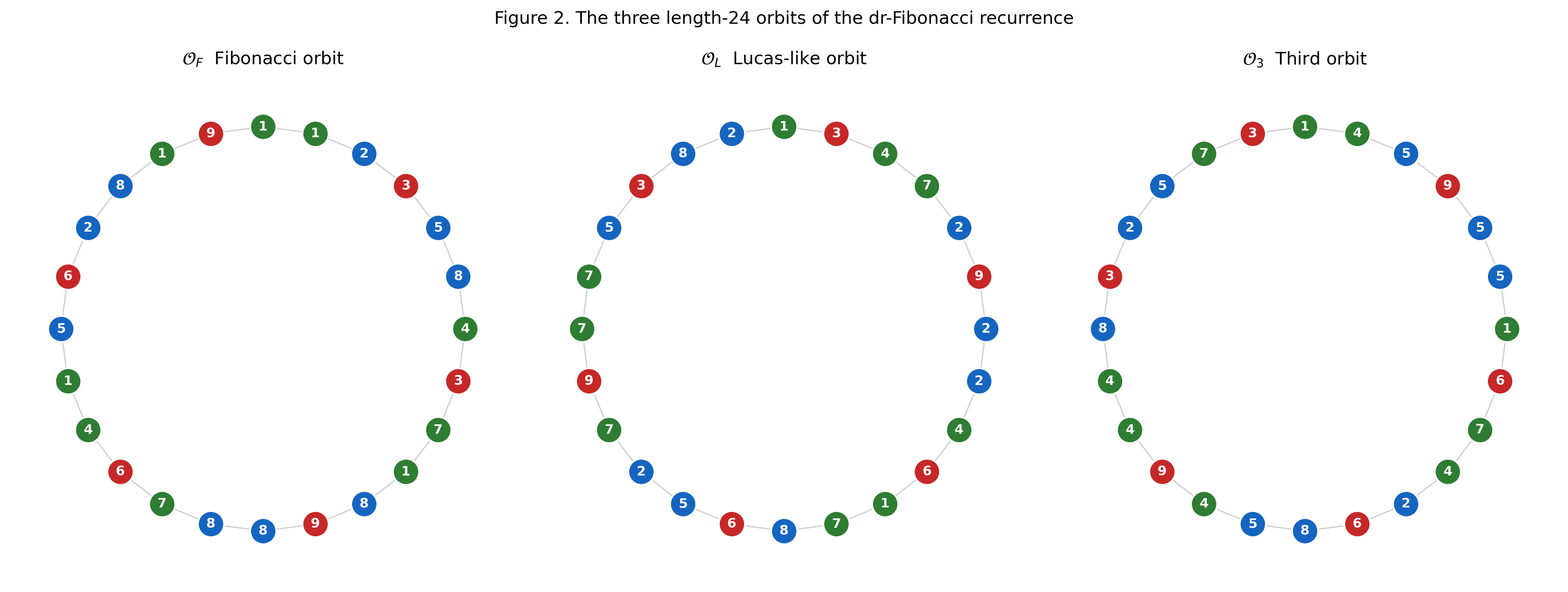
Theorem 3.1 (Orbit decomposition). The map T partitions {1, …, 9}² ⊂ Z/9Z × Z/9Z into exactly five disjoint orbits:
-
Fibonacci orbit
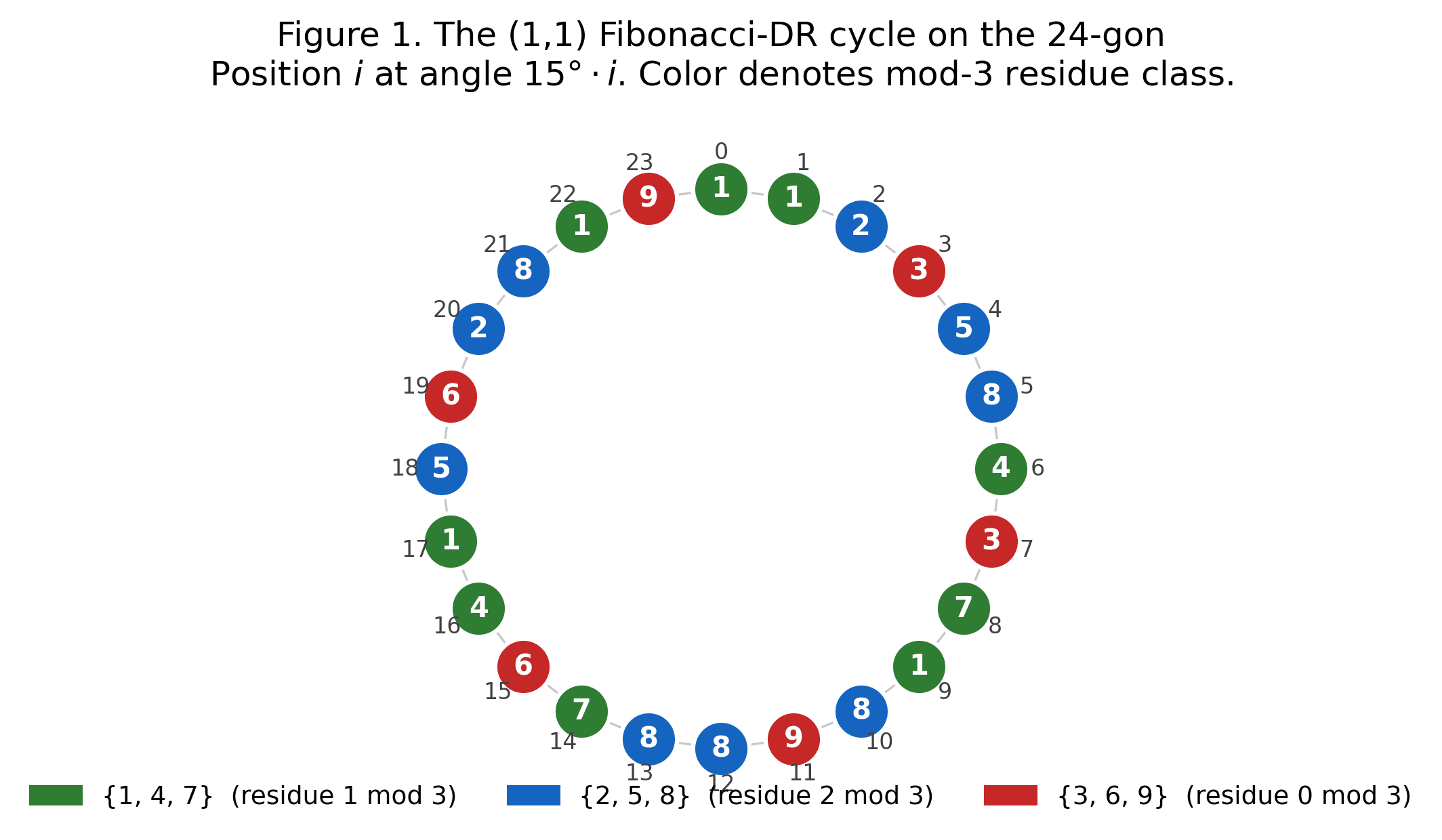
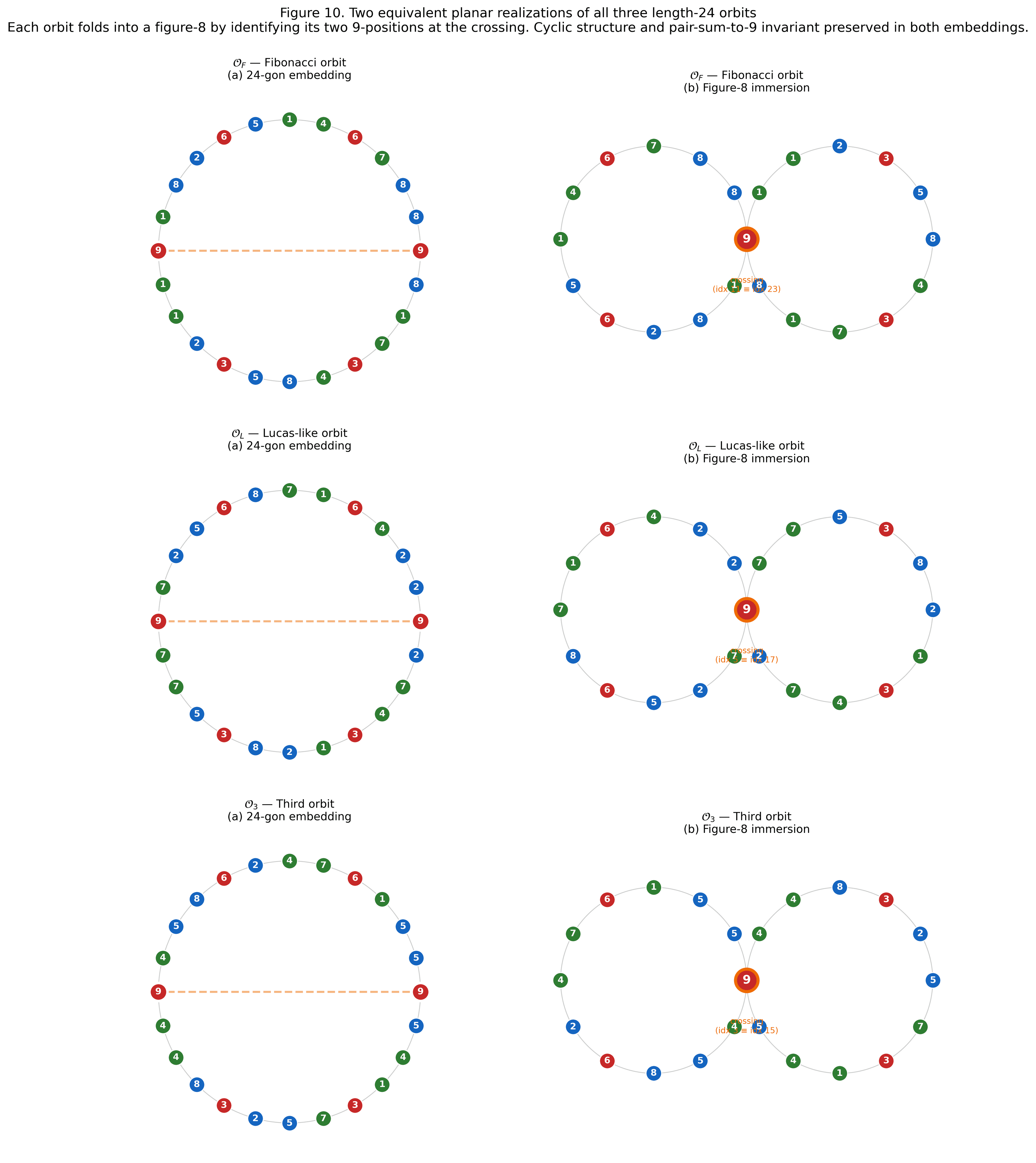
O_F(length 24), seeded by(1, 1):[1, 1, 2, 3, 5, 8, 4, 3, 7, 1, 8, 9, 8, 8, 7, 6, 4, 1, 5, 6, 2, 8, 1, 9] -
Lucas-like orbit
O_L(length 24), seeded by(1, 3):[1, 3, 4, 7, 2, 9, 2, 2, 4, 6, 1, 7, 8, 6, 5, 2, 7, 9, 7, 7, 5, 3, 8, 2] -
Third orbit
O_3(length 24), seeded by(1, 4):[1, 4, 5, 9, 5, 5, 1, 6, 7, 4, 2, 6, 8, 5, 4, 9, 4, 4, 8, 3, 2, 5, 7, 3] -
Binding orbit
O_B(length 8), seeded by(3, 6), supported on{3, 6, 9}:[3, 6, 9, 6, 6, 3, 9, 3] -
Fixed point
(9, 9), generating the constant sequence9, 9, 9, ….
The orbit sizes total 24 + 24 + 24 + 8 + 1 = 81, exhausting {1, …, 9}².
Proof. T is a bijection on the finite set, so orbits partition. Direct iteration from each seed determines its orbit length and content; the totals match 9² = 81. ∎
Corollary 3.2 (Universality). Every (a, b) ∈ Z₊² generates a dr-Fibonacci sequence whose orbit equals one of the five orbits above. The orbit is determined by (dr(a), dr(b)).
Proof. dr commutes with the recurrence, so the orbit of (a, b) equals the orbit of (dr(a), dr(b)) ∈ {1, …, 9}². ∎
3.3 Orbital invariance
Proposition 3.3. Each length-24 orbit is rotationally invariant: for any orbit O and any i ∈ {0, …, 23}, the pair (O[i], O[i+1]) is itself a seed pair lying in O, and iteration from this seed traces O starting at index i.
Proof. T is the orbit's defining permutation. T^k(a, b) is on the orbit of (a, b) for all k. ∎
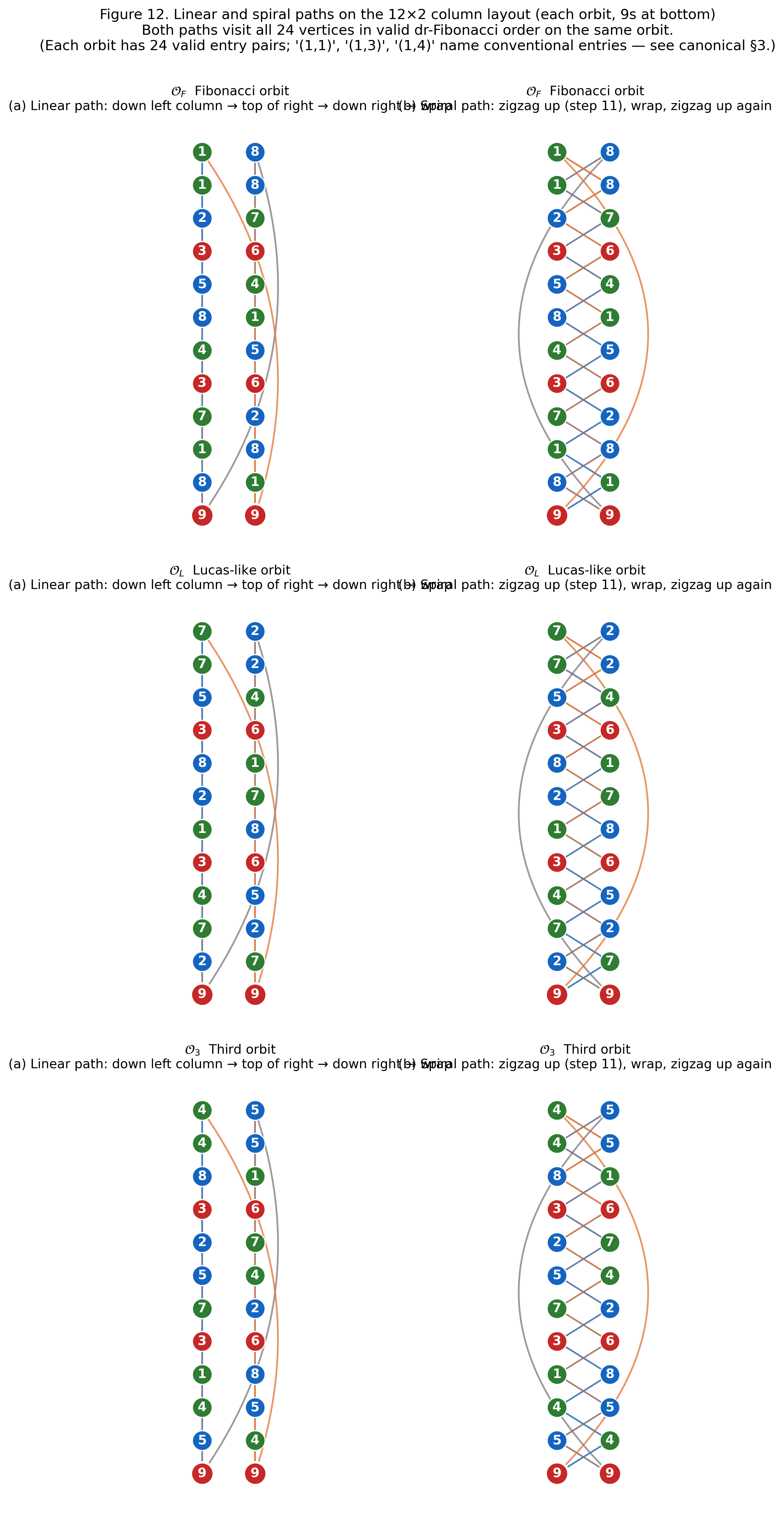
Remark 3.3.1 (Naming convention). Each length-24 orbit therefore has 24 valid seed pairs, not one. We name the orbits O_F, O_L, O_3 ("Fibonacci," "Lucas-like," "Third"), and use the parenthetical (1, 1), (1, 3), (1, 4) as conventional identifiers: typically the lexicographically smallest seed pair on each orbit. By Proposition 3.3, however, any of the 24 consecutive pairs in an orbit is an equivalent seed. For example, on O_F, the pair (8, 8) (which appears at indices 12 and 13 of the canonical cycle written above) is just as valid a seed as (1, 1) and produces the same 24-cycle in shifted phase. Throughout the paper we use the parenthetical seed-pair notation only as a label for the orbit, never as a privileged starting position.
3.4 The {3, 6, 9} ideal
The set {3, 6, 9} (together with 0) is the additive subgroup 3Z/9Z ⊂ Z/9Z, which is also the maximal ideal of the ring Z/9Z. It is closed under both addition and multiplication.
Proposition 3.4. A pair (a, b) ∈ {1, …, 9}² lies in O_B or at the fixed point (9, 9) if and only if both a and b are divisible by 3. Otherwise (a, b) lies in one of O_F, O_L, O_3.
Proof. If 3 | a and 3 | b, then 3 | xₙ for all n by induction, so the orbit lies in {3, 6, 9}, which is precisely O_B ∪ {(9, 9)}. Conversely, if at least one of a, b is coprime to 3, then xₙ cannot be in {3, 6, 9} for all n, since an O_B orbit cannot contain a value coprime to 3. Hence (a, b) lies in one of the three length-24 orbits. ∎
This provides the practical "binding caveat": to seed a length-24 orbit, at least one of the inputs must be coprime to 3.
4. Coset Decomposition: The 9 + 9 + 6 Split
The ring Z/9Z decomposes as a disjoint union of three cosets of the subgroup 3Z/9Z:
Z/9Z = {1, 4, 7} ⊔ {2, 5, 8} ⊔ {3, 6, 9}.
These are the residues 1, 2, 0 modulo 3, respectively.
Theorem 4.1. Every length-24 orbit (O_F, O_L, O_3) distributes its 24 positions across the three cosets in the proportion 9 + 9 + 6 = 24.
Proof. The number of positions in O whose value lies in {3, 6, 9} equals the number of indices n ∈ {0, …, 23} for which the underlying Fibonacci-type term at that index is divisible by 3. The Pisano period of Fₙ modulo 3 is 8, with Fₙ ≡ 0 (mod 3) iff n ≡ 0 (mod 4). Within {0, …, 23} there are exactly 24/4 = 6 such indices.
The remaining 18 indices distribute evenly between residues 1 and 2 modulo 3. To see this: the involution σ : (Z/3Z)* → (Z/3Z)* defined by σ(a) = −a (i.e., σ(1) = 2, σ(2) = 1) extends to an involution on dr-Fibonacci orbits that preserves length-24 cycles and exchanges the residue-1 positions with residue-2 positions. The exchange is bijective, hence the residue-1 and residue-2 counts are equal; together they sum to 18. ∎
5. Geometric Properties on the 24-gon
We embed each length-24 orbit on the regular 24-gon: position i ∈ {0, …, 23} lies at angle 15° · i on a unit circle.
5.1 Antipodal involution
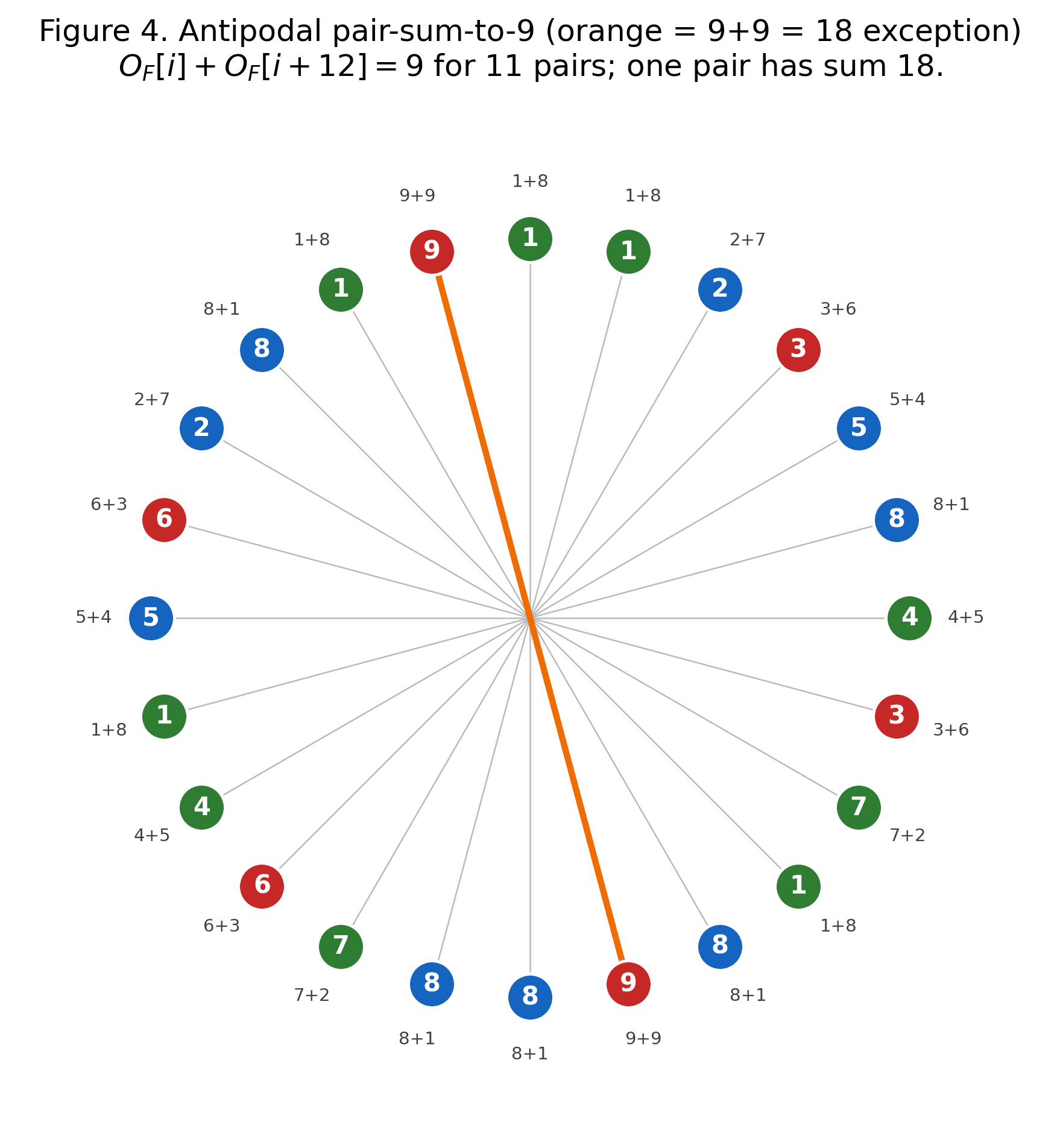
Position i and position i + 12 (mod 24) are antipodal on the 24-gon (separated by 180°).
Theorem 5.1. For any length-24 orbit O and any i ∈ {0, …, 23}:
O[i] + O[(i + 12) mod 24] ∈ {9, 18}.
The sum equals 18 at exactly one antipodal pair (where both positions hold 9), and 9 at the remaining 11 antipodal pairs.
Proof. The Pisano period π(9) = 24 has the half-period property Fₙ₊₁₂ ≡ −Fₙ (mod 9) for all n [Wal60, §3]. Therefore:
- If
dr(Fₙ) ≠ 9(equivalently,Fₙ ≢ 0 (mod 9)), thendr(Fₙ₊₁₂) = 9 − dr(Fₙ), so the antipodal sum isdr(Fₙ) + (9 − dr(Fₙ)) = 9. - If
dr(Fₙ) = 9(equivalently,Fₙ ≡ 0 (mod 9)), thendr(Fₙ₊₁₂) = 9as well, giving sum18.
Each length-24 orbit has exactly two positions equal to 9 (these are the indices where Fₙ ≡ 0 (mod 9) within the period), separated by 12 indices, so exactly one antipodal pair has both endpoints equal to 9. ∎
5.2 The asymmetric self-mirror
Theorem 5.1 establishes a 9's-complement involution: each pair of antipodal positions (i, i+12) either satisfies O[i] + O[i+12] = 9, or the asymmetric exception O[i] = O[i+12] = 9. We refer to this as the asymmetric self-mirror: the cycle is mirror-symmetric across its diameter, with 9 as a fixed point of the mirror rather than mapping to 0. The asymmetry is a direct consequence of the dr convention identifying 0 with 9 for nonzero classes.
5.3 Spiral self-similarity (step-11 traversal)
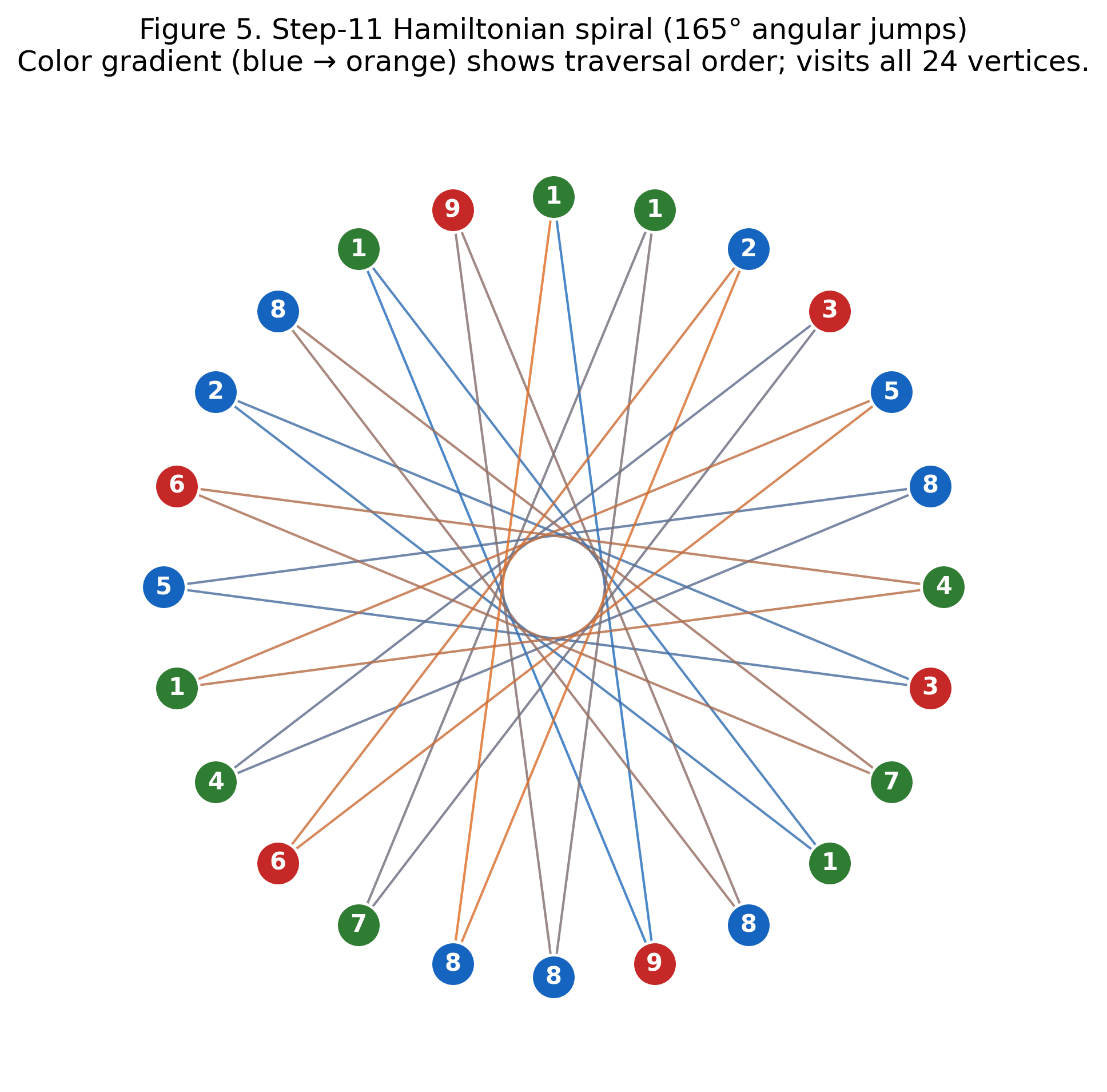
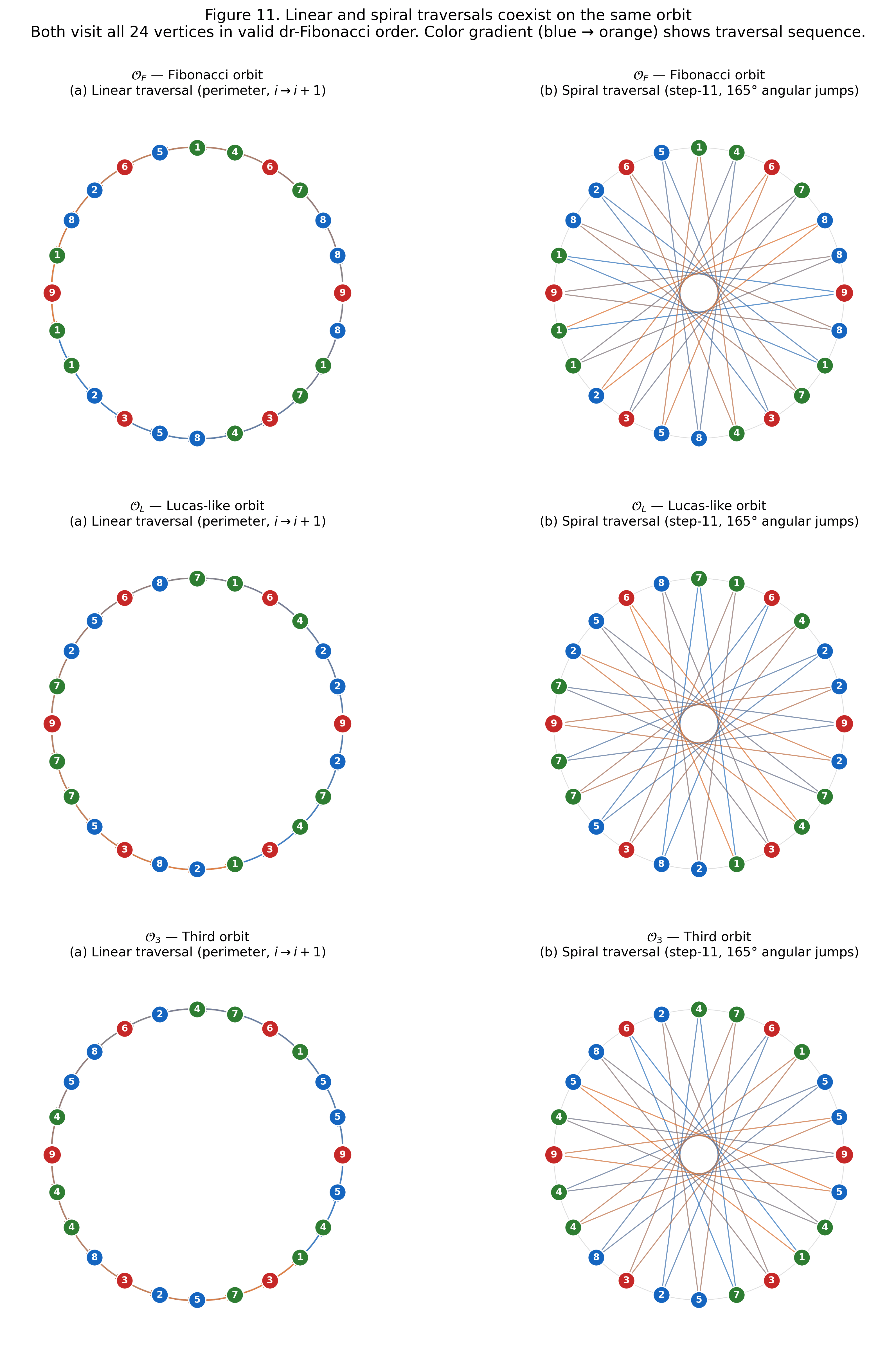
Consider the traversal i ↦ (i + 11) (mod 24). Since gcd(11, 24) = 1, this is Hamiltonian on the 24-cycle.
Theorem 5.2. For any length-24 orbit O, the sequence
O[0], O[11], O[22], O[9], O[20], O[7], …
(indices stepping by 11 modulo 24) is itself a valid dr-Fibonacci sequence, equivalently, it is O traversed starting from a different index.
Proof sketch. The dr-Fibonacci recurrence acts on consecutive pairs. If (O[i], O[i + 11]) is itself a pair lying on the orbit (necessarily, since both endpoints lie on O), then the step-11 traversal coincides with the orbit started from this pair. Verified directly for O_F, O_L, O_3 by computation. ∎
Geometrically: 165° angular jumps around the 24-gon trace the orbit at a rotated phase. The visual realization in a 4 × 6 column-major layout is a zigzag traversal that ascends through alternating columns and wraps around.
5.4 Backward traversal and the pair-sign inversion
The dr-Fibonacci recurrence is reversible: from any consecutive pair (x_n, x_{n+1}) in a length-24 orbit, the previous term is recovered by
x_{n-1} = (x_{n+1} - x_n) (mod 9), with the convention 0 ↔ 9.
In the strictly dr-reduced cycle, x_{n+1} - x_n ∈ {-8, …, 8}. When the raw difference is non-negative, applying dr directly gives x_{n-1}. When the raw difference is negative, however, naive absolute value followed by dr gives the pair of x_{n-1} (that is, 9 - x_{n-1}) rather than x_{n-1} itself.
Corollary 5.5 (Pair-sign inversion under backward traversal). Let r = x_{n+1} - x_n denote the raw backward difference computed in Z (not yet reduced). Then:
- If
r > 0,x_{n-1} = dr(r). - If
r = 0,x_{n-1} = 9(by the0 ↔ 9convention). - If
r < 0,x_{n-1} = 9 - dr(|r|)whendr(|r|) ≠ 9, andx_{n-1} = 9whendr(|r|) = 9.
Equivalently: when the raw backward step is negative, the digital root of its absolute value gives the antipodal pair of the correct previous value. The correct value is recovered as 9 - dr(|r|).
Proof. In Z/9Z, -k ≡ 9 - dr(k) (mod 9) for k ≢ 0 (mod 9). The sign-stripping operation r ↦ |r| discards the negation; the pair map x ↦ 9 - x is precisely the negation in Z/9Z and restores it. The result follows from the homomorphism property of dr. Equivalently, this is the same algebraic fact as the half-period property F_{n+12} ≡ -F_n (mod 9) underlying the antipodal involution (Theorem 5.1). ∎
Remark 5.6. Raw differences of magnitude greater than 9 do not arise in the strictly dr-reduced cycle (where |r| ≤ 8), but they do arise in backward computations on the underlying non-reduced Fibonacci-type sequence. The rule applies in either context. For example: a raw backward difference of -11 gives dr(|-11|) = dr(11) = 2, with pair 9 - 2 = 7; the correct backward answer is 7.
Remark 5.7 (The 0 ≡ 9 identification, revealed by backward traversal). The case r = 0 in Corollary 5.5 deserves separate comment. When the raw backward difference is exactly zero, the correct previous value is 9, not 0. In Z/9Z the residues 0 and 9 are literally the same equivalence class (9 ≡ 0 mod 9), and the choice of 9 as the canonical representative is forced by the requirement that the dr-Fibonacci sequence on positive integers stay in {1, …, 9}.
The backward case makes this identification structural rather than conventional: when forward addition produces a multiple of 9, we record 9; when backward subtraction produces exactly 0, we recover that the previous value was 9. The two are the same algebraic fact, the additive identity 0 and the maximum-symbol representative 9 are interchangeable, and they appear at exactly the antipodal 9-9 boundaries of the cycle (Theorem 5.1) precisely because that is where the underlying Fibonacci-type integer is divisible by 9. The 0 ↔ 9 convention is therefore not an arbitrary choice; it is the unique self-consistent representation under which the recurrence is reversible.
Corollary 5.5 makes the geometric picture of §5.1 unambiguous when traversing the orbit in either direction. It also has a practical interpretation in the context of the companion engineering paper [in preparation]: an observer who knows the current state of two adjacent wheel stations and wishes to recover the upstream configuration must apply the pair-rule whenever the raw backward subtraction is negative.
5.5 The lemniscate (figure-8) immersion
The 24-cycle is topologically a circle S¹. We have so far worked with the standard regular 24-gon embedding in the plane. A second equally valid planar realization is the lemniscate (figure-8) immersion: draw the loop so that the two 9-positions (which are antipodal in the cyclic order, separated by 12 indices) coincide at a single planar crossing point. The result is a figure-8 with two lobes, each containing 11 of the 24 cycle positions, connected at a central self-intersection where both 9s coincide.
The cyclic structure is unchanged. The cycle is still a single closed loop visiting all 24 positions in order; only the planar embedding has changed from an embedding (no self-intersections) to an immersion (one self-intersection at the crossing). All structural invariants (the antipodal pair-sum-to-9 (Theorem 5.1), the asymmetric self-mirror, orbital invariance (Proposition 3.3)) are preserved because they live in the cyclic order, not in the planar realization.
Remark 5.8 (Topology of the figure-8 immersion). The figure-8 immersion has the structural property that the loop visibly returns to itself at the crossing, what the classical iconography of the ouroboros represents as a snake eating its own tail. In our setting, this is the geometric statement that:
- The cycle has no privileged starting position (orbital invariance, Proposition 3.3); equivalently, traversal direction is also a free choice.
- The recurrence is invertible (Corollary 5.5); forward and backward iteration are both well-defined and traverse the same orbit.
- The additive-identity class
0 ∈ Z/9Zand its representative9coincide (Remark 5.7); the loop "closes" exactly where it visibly self-intersects.
The figure-8 immersion is also the natural topology of the companion device [in preparation]: the two physical wheels are the two lobes of one figure-8, with the magnetic coupling region as the central crossing. The 9-9 antipodal pair is fixed at the crossing; every other station passes through it transiently as the wheels rotate.
5.6 The regular hexagonal sublattice
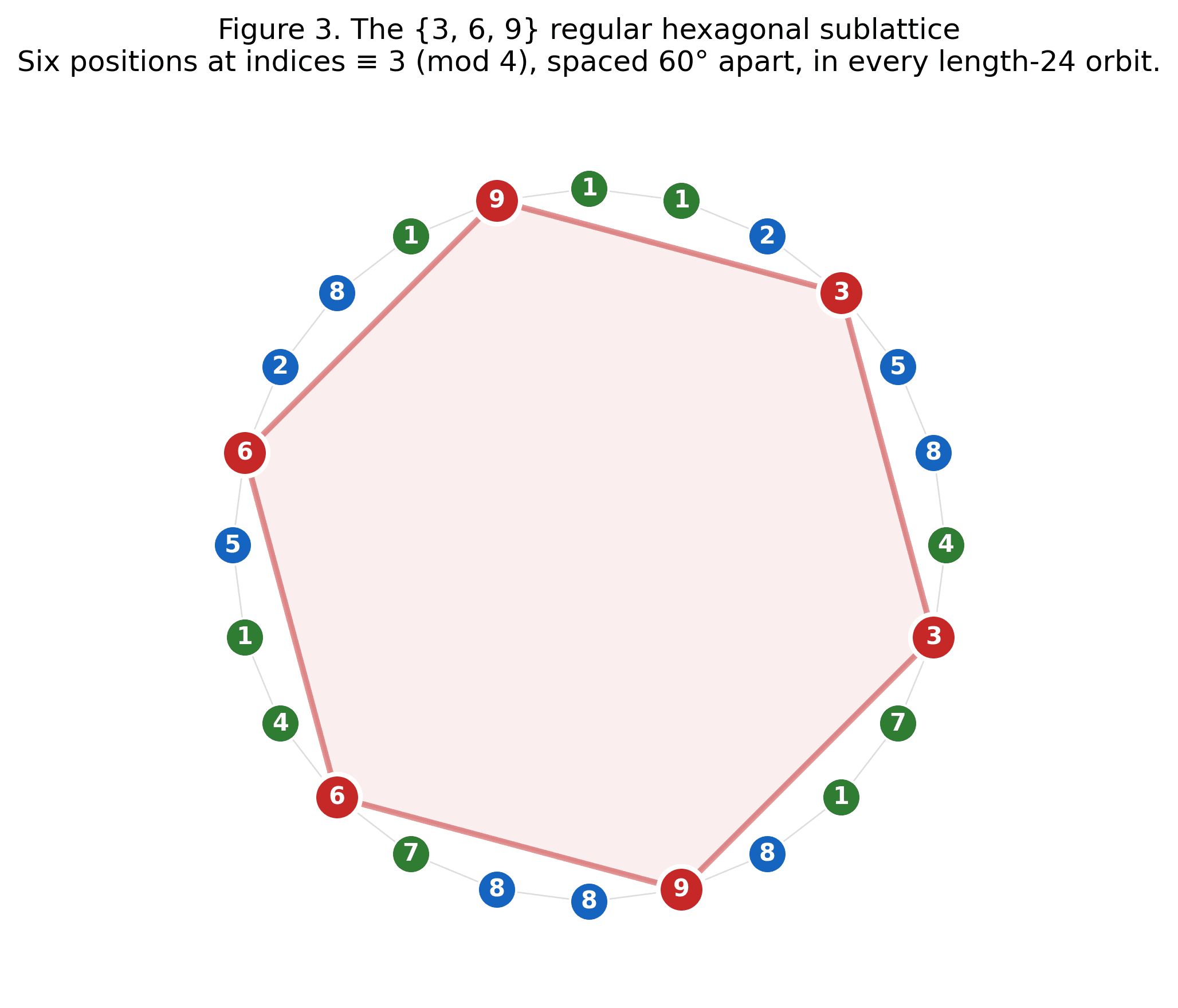
The 6 positions in each length-24 orbit holding values in {3, 6, 9} are spaced exactly 4 indices apart, forming a regular hexagon (60° spacing) on the 24-gon.
Proposition 5.3. For any length-24 orbit O, the set {i ∈ {0, …, 23} : O[i] ∈ {3, 6, 9}} is a 6-element arithmetic progression with common difference 4 modulo 24.
Proof. Position i holds a value in {3, 6, 9} iff Fₙ ≡ 0 (mod 3) (where n is the appropriate index for the orbit's seed). The Pisano period of F modulo 3 is 8, and Fₙ ≡ 0 (mod 3) iff n ≡ 0 (mod 4). Within the 24-cycle, this gives 6 positions at uniform spacing 4. ∎
Corollary 5.4. Inscribed regular polygons of vertex count k ∈ {3, 6} (and irregular rectangles formed from antipodal pairs of hexagon vertices) admit rotational alignments where all vertices lie on {3, 6, 9} positions of the 24-cycle. Polygons of vertex count k ∉ {1, 2, 3, 6} (e.g., squares with k = 4, octagons with k = 8, dodecagons with k = 12) cannot have all vertices on {3, 6, 9}.
Proof. The hexagonal sublattice has 6 vertices. Inscribed polygons with all vertices on this sublattice must have vertex count dividing 6. ∎
6. Angle Arithmetic in Standard Geometry
The pair-sum-to-9 structure of the antipodal involution (§5.1) is not specific to dr-Fibonacci sequences. The same algebraic phenomenon manifests in standard angle arithmetic.
Theorem 6.1. For any polygon (in the standard Euclidean sense), the sum of digital roots of its interior angles is congruent to 9 modulo 9:
Σᵢ dr(αᵢ) ≡ 9 (mod 9).
Proof. The interior angles of an n-gon sum to (n − 2) · 180°. Since 180 = 9 · 20, the sum is divisible by 9. Because dr is a homomorphism modulo 9:
Σᵢ dr(αᵢ) ≡ dr(Σᵢ αᵢ) = dr((n − 2) · 180) = 9 (mod 9).
That establishes the result. ∎
Corollary 6.2. Complementary angle pairs (α + β = 90°), supplementary angle pairs (α + β = 180°), and full-rotation pairs (α + β = 360°) all have digital roots summing to 9, with 9 + 9 = 18 as the asymmetric exception when both angles have digital root 9.
The structural parallel to §5.1 is exact. Both phenomena arise from the same algebraic root: 9 is the additive identity in dr arithmetic, and 90, 180, 360 are all multiples of 9. The dr-Fibonacci 24-cycle and standard angle arithmetic share this structure for the same reason.
Remark 6.3 (Convention dependence). Theorem 6.1 depends on the degree convention (360° = full rotation), under which 90, 180, 360 are integers divisible by 9. In radians, where the full rotation is 2π, the analogous statement does not hold: dr is only defined on integers, and there is no integer arithmetic interpretation of 2π. The result is therefore a feature of the degree convention specifically, not of Euclidean geometry per se.
7. The Mod-4 Decomposition: Additive Cycle Reveals Multiplicative Structure
The central new structural result of this paper.
7.1 Definition of the decomposition
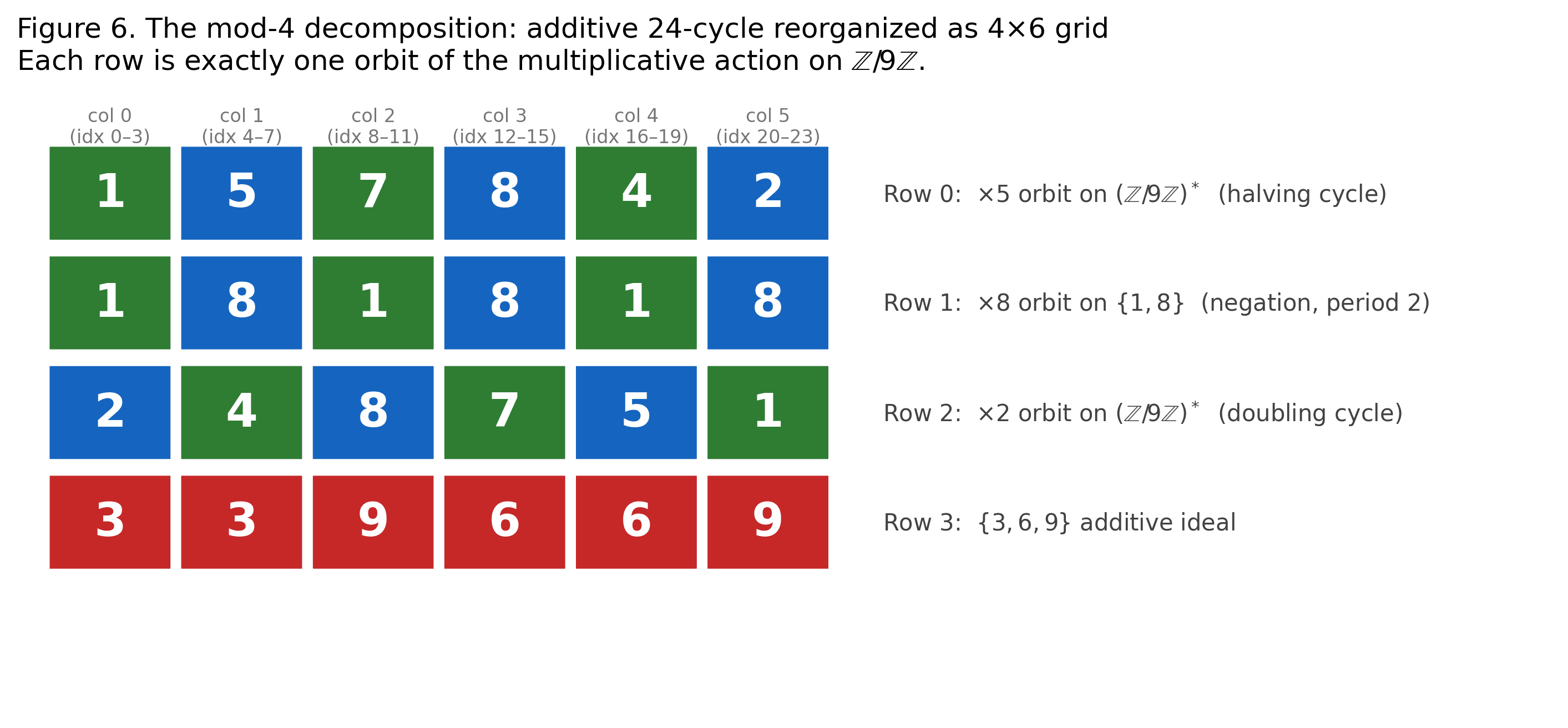
For any length-24 orbit O and each residue class r ∈ {0, 1, 2, 3} modulo 4, define the r-th mod-4 row:
Rᵣ(O) = (O[r], O[r + 4], O[r + 8], O[r + 12], O[r + 16], O[r + 20]).
Rᵣ(O) is the subsequence of O at indices congruent to r modulo 4, in cycle order. Each Rᵣ(O) has length 6, and the four rows together exhaust the 24 positions of the orbit.
This is the row decomposition obtained by laying O in a 4 × 6 column-major grid: column c holds positions (4c, 4c+1, 4c+2, 4c+3), and row r is Rᵣ(O).
7.2 The four multiplicative orbits of Z/9Z
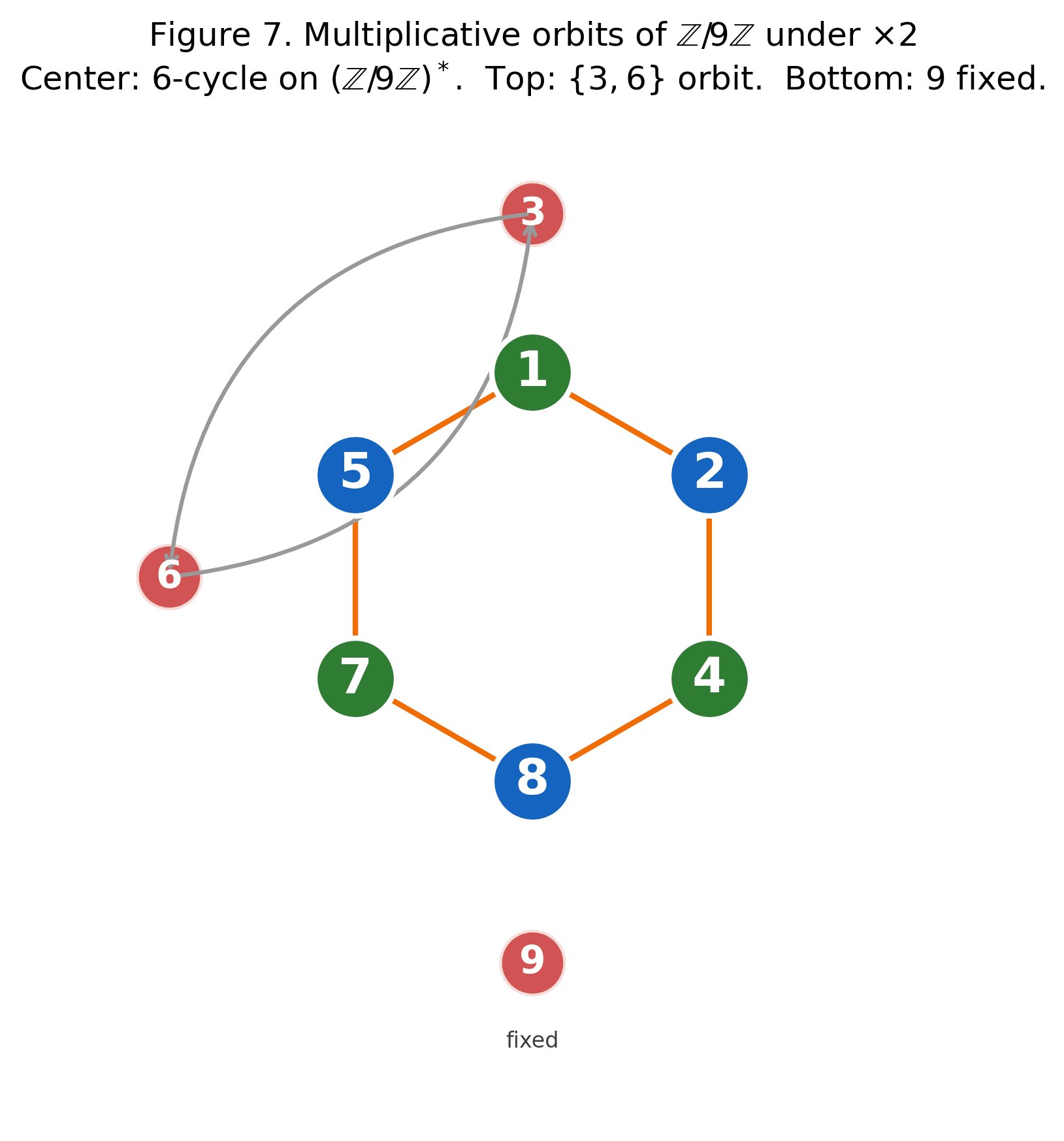
The multiplicative monoid (Z/9Z, ·) acts on Z/9Z by left multiplication. The unit group (Z/9Z)* = {1, 2, 4, 5, 7, 8} is cyclic of order 6, with generator 2:
2¹ = 2, 2² = 4, 2³ = 8, 2⁴ = 16 ≡ 7, 2⁵ = 14 ≡ 5, 2⁶ = 10 ≡ 1.
The four orbits of the monoid action Z/9Z × {1, 2, 5, 8} → Z/9Z (multiplication by elements of (Z/9Z)* acting on a chosen base point) are:
(M1) Doubling 6-cycle: (1, 2, 4, 8, 7, 5), orbit of 1 under × 2. All units of (Z/9Z)*.
(M2) Halving 6-cycle: (1, 5, 7, 8, 4, 2), orbit of 1 under × 5. Same set of units, traversed in reverse direction (since 5 = 2⁻¹ (mod 9)).
(M3) Negation 2-cycle: (1, 8) = (1, −1), orbit of 1 under × 8. Period 2 (since 8² = 64 ≡ 1 (mod 9)). Translates (2, 7) and (4, 5) are the same orbit on different base points.
(M4) {3, 6, 9} additive ideal: the maximal ideal 3Z/9Z, closed under both + and ·.
7.3 The decomposition theorem
Theorem 7.1. Let O ∈ {O_F, O_L, O_3} be a length-24 orbit. Each of the four mod-4 rows R₀(O), R₁(O), R₂(O), R₃(O) is exactly one of the multiplicative orbits (M1)–(M4), with the assignment depending on the orbit's rotational phase. Specifically:
For O_F:   R₀ = (M2),  R₁ = (M3),  R₂ = (M1),  R₃ = (M4).
For O_L:   R₀ = (M1),  R₁ = (M4),  R₂ = (M2),  R₃ = (M3).
For O_3:   R₀ = (M2),  R₁ = (M3),  R₂ = (M1),  R₃ = (M4).
(More precisely: R₀(O_F) = (1, 5, 7, 8, 4, 2), R₁(O_F) = (1, 8, 1, 8, 1, 8), R₂(O_F) = (2, 4, 8, 7, 5, 1), R₃(O_F) = (3, 3, 9, 6, 6, 9), and analogously for O_L, O_3.)
Proof. By direct verification on the three cycles. The structural reason follows from the matrix form of the Fibonacci recurrence. Let
M = [[1, 1], [1, 0]]
so that Mⁿ · [F₁, F₀]ᵀ = [Fₙ₊₁, Fₙ]ᵀ. Then
M⁴ = [[5, 3], [3, 2]] (mod 9).
This gives the step-4 recurrence: if (xₙ, xₙ₊₁) is a state in the dr-Fibonacci sequence, then
xₙ₊₄ ≡ 3 xₙ₊₁ + 2 xₙ (mod 9).
Equivalently, fixing the second coordinate b:
xₙ₊₄ ≡ 5 b + 3 a (when computed from base pair (a, b)),
and iterating, the step-4 subsequence at each fixed phase r is generated by left-multiplication of an initial value by either 2 or 5 modulo 9, depending on the phase. The four phases yield (M1), (M2), (M3) (in the special case of period-2 alternation), and (M4) (when the phase falls on {3, 6, 9}-valued positions). ∎
7.4 Significance
Theorem 7.1 establishes that the additive 24-cycle of dr-Fibonacci and the multiplicative orbits of Z/9Z are not separate phenomena. They are the same algebraic object expressed in two coordinate systems. The mod-4 reorganization is the explicit transformation between them.
To our knowledge, this decomposition has not previously been documented in the literature in this form, although the underlying ingredients (Pisano period mod 9, the matrix form of Fibonacci, the cyclic structure of (Z/9Z)*) are classical [Wal60, Vaj89].
8. Connection to Prime Distribution Modulo 24
We close with a structural connection (not a predictive result) to prime distribution.
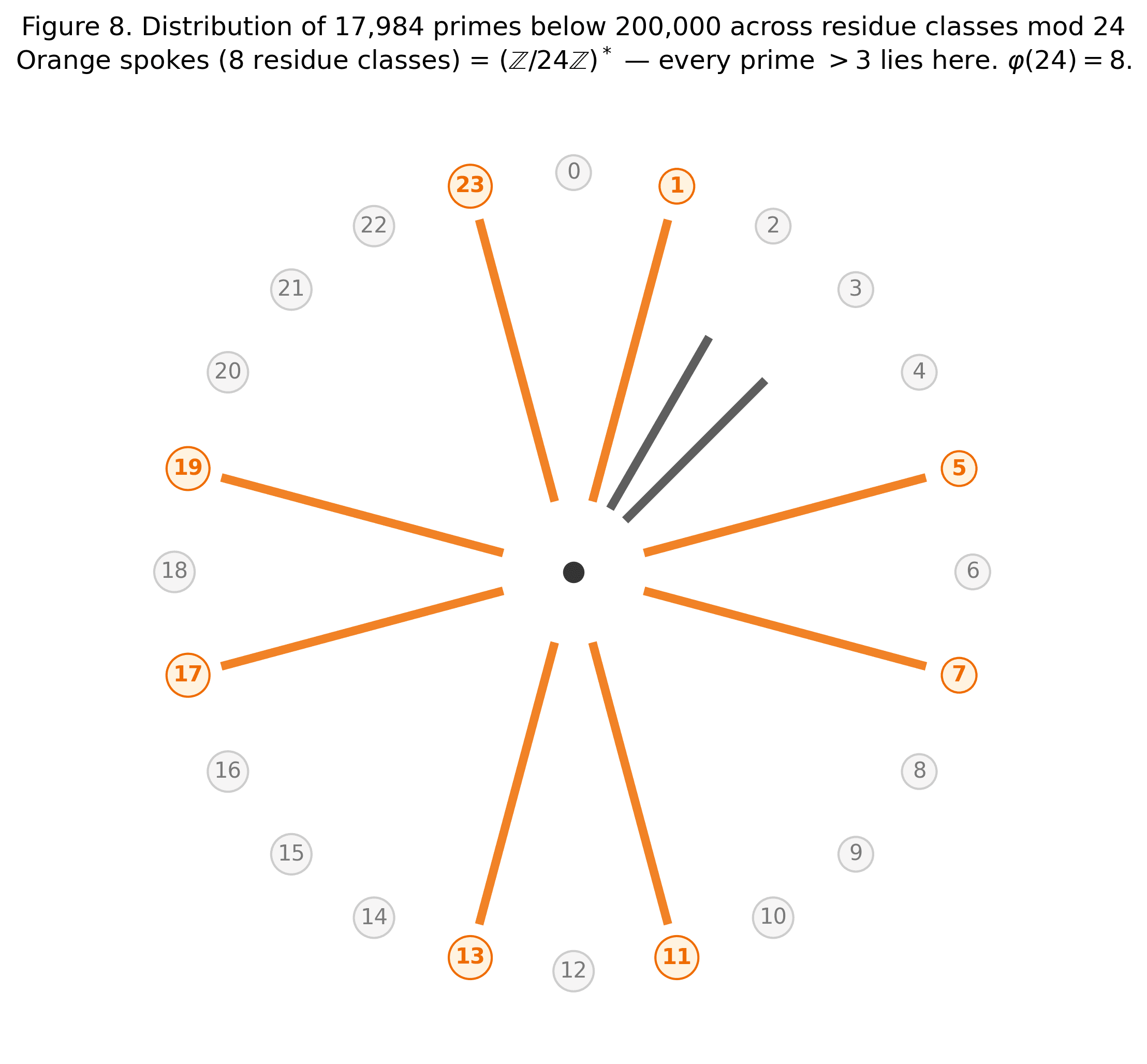
Theorem 8.1 (classical). Every prime p > 3 satisfies p (mod 24) ∈ (Z/24Z)* = {1, 5, 7, 11, 13, 17, 19, 23}. Conversely, the residue classes {0, 2, 3, 4, 6, 8, 9, 10, 12, 14, 15, 16, 18, 20, 21, 22} contain no primes greater than 3.
Proof. A prime greater than 3 must be coprime to 24 = 2³ · 3. The residues coprime to 24 are precisely the units (Z/24Z)*, of which there are φ(24) = 8. ∎
Remark 8.2 (Structural unification). The integer 24 plays two distinct roles in this paper:
- As
π(9) = 24(the Pisano period of Fibonacci modulo 9), it determines the additive structure of dr-Fibonacci sequences (§§3–7). - As an integer with
φ(24) = 8, it determines the residue classes hosting all primes greater than 3.
Both roles arise from the prime factorization 24 = 2³ · 3. The additive role arises through the Pisano period mod 9, where 9 = 3². The multiplicative role arises through the Euler totient, which depends on the same prime factorization. The integer 24 thereby organizes both the additive Fibonacci structure mod 9 and the multiplicative coprimality structure governing prime distribution.
We emphasize that Remark 8.2 is a structural unification, not a predictive consequence for prime distribution. Theorem 8.1 is unaffected by anything in this paper; we observe only that the same integer 24 appears in two contexts as a consequence of properties of its prime factorization.
9. Discussion
9.1 Fibonacci appearances in physical systems
Fibonacci sequences arise in several physical systems where efficient packing or growth under angular constraint produces them as natural solutions. The most well-documented is phyllotaxis: the arrangement of leaves, scales, or florets around a stem [Mit77, DC92]. The spiral arrangements of sunflower seeds, pinecone scales, and pineapple sections all exhibit Fibonacci numbers as the counts of clockwise and counterclockwise spirals, as a consequence of the golden angle being a limiting solution to optimal angular packing under iterative growth.
A separate engineering paper [in preparation] presents another instance: a magnetically-coupled pair of mechanical wheels whose mass distribution at 12 angular stations follows the dr-Fibonacci 24-cycle in the manner described by §§3–7. The device is a coupled-oscillator demonstration whose mass-distribution design derives from the orbit structure of this paper.
9.2 Two physical realizations of the same algebraic class
Remark 5.7 has a direct physical consequence in the companion engineering paper [in preparation]. The wheel device places weights at 12 angular stations on each of two coupled wheels, with one antipodal pair carrying the 9 + 9 configuration of Theorem 5.1. The dr-class of 9 + 9 is 0 ≡ 9 (mod 9), which admits two physical representatives in the device:
- Load 18: each wheel's special-pair station holds 9 weights, total mass-pair = 18 weights.
- Load 0: each wheel's special-pair station is empty, total mass-pair = 0 weights.
Both configurations preserve the (n − 2) · 180-degree-style algebraic constraint on the residues; both are valid representatives of the same Z/9Z class. The physical dynamics they produce, however, differ substantially, one provides maximal torque differential at the special station, the other a "void" (a balanced patch in an otherwise asymmetric ring). The experimental comparison is therefore a direct probe of which physical representative of an algebraically equivalent class produces preferable coupled-oscillator behavior. The math is silent on the choice; the physics decides.
Three independent degrees of freedom. The wheel design realizes a single abstract orbit through three independent design parameters, all algebraically equivalent:
- Orbit choice. One of the three length-24 orbits (
O_F,O_L, orO_3) determines the per-station weight pattern up to rotation. - Rotational placement. By orbital invariance (Proposition 3.3), the cycle has no privileged starting index. The special-pair station can sit at any of the 12 physical stations (top, bottom, side) without affecting the algebraic structure.
- Representative choice. The
9 + 9antipodal pair can carry either physical sum (18(load) or0(empty)) as the two representatives of the sameZ/9Zclass.
All three choices preserve the underlying orbit; only the physical dynamics distinguish them. The wheel is therefore a single abstract object with a multi-parameter family of physical realizations.
9.3 Open questions
-
Generalization to other Pisano periods. The orbit decomposition of §3 has the convenient property that
π(9) = 24is small. Analogous orbit decompositions fordr_n-Fibonacci sequences modulo other smalln(especiallyn = 11, 12, 16) are open. -
The mod-
kdecomposition for general moduli. Theorem 7.1's mod-4 decomposition exposes multiplicative structure in the caseπ(9) = 24where24/4 = 6 = |(Z/9Z)*|. Whether analogous decompositions exist for other Pisano periods (π(m)/k = |(Z/mZ)*|for somekdividingπ(m)) is open. -
Connection to Wall–Sun–Sun primes. A Wall-Sun-Sun prime is a prime
psuch thatp² | F_{π(p)}(equivalently,π(p²) = π(p)). None are known; whether infinitely many exist is open. The structural connection between Pisano periods and Euler totients raised in §8 may suggest avenues.
9.4 Limitations
The orbit decomposition (Theorem 3.1) is computational over a finite (81-element) domain. The geometric and structural results (§§5, 7) follow from classical Pisano-period theory and small-case verification. We do not claim generalization beyond π(9) = 24 except where explicitly stated.
References
[DC92] S. Douady and Y. Couder. Phyllotaxis as a physical self-organized growth process. Physical Review Letters 68 (1992), 2098–2101.
[HW08] G. H. Hardy and E. M. Wright. An Introduction to the Theory of Numbers. 6th edition, edited by D. R. Heath-Brown and J. H. Silverman. Oxford University Press, 2008.
[Mit77] G. J. Mitchison. Phyllotaxis and the Fibonacci series. Science 196 (1977), 270–275.
[OEIS] N. J. A. Sloane et al. The On-Line Encyclopedia of Integer Sequences. https://oeis.org. Especially A001175 (Pisano periods), A007887 (Fibonacci sequence reduced modulo 9 keeping 9 for 0).
[Vaj89] S. Vajda. Fibonacci and Lucas Numbers, and the Golden Section: Theory and Applications. Ellis Horwood, 1989. Reprinted by Dover, 2008.
[Wal60] D. D. Wall. Fibonacci series modulo m. American Mathematical Monthly 67 (1960), no. 6, 525–532.
Appendix A. Computational Verification
All claims in this paper have been computationally verified using the open-source companion implementation at magnetic_gear/sequences.py (in the repository accompanying [companion engineering paper]). The verification covers:
- Theorem 3.1: enumeration of orbits over all 81 single-digit pairs.
- Theorem 4.1:
9 + 9 + 6partition verified for all three length-24 orbits. - Theorem 5.1: antipodal involution
O[i] + O[i+12] ∈ {9, 18}verified for all 24 positions of all three orbits. - Theorem 5.2: step-11 traversal verified to satisfy the dr-Fibonacci recurrence and to be a rotation of the source orbit, for all three orbits.
- Proposition 5.3: hexagonal sublattice verified for all three orbits.
- Theorem 7.1: row decomposition verified for all three orbits, with multiplicative-orbit identification.
- Theorem 8.1: prime distribution verified empirically for all primes below 200,000 (17,984 primes), all of which fall in the 8 unit residue classes mod 24.
Figures
Reference figures from the paper. Sources reproducible from the paper's figures directory.
Related papers
dr-Fibonacci (popular)
Quanta-style accessible introduction to the orbit structure of digital-root Fibonacci sequences for non-specialist readers.
Infinity Wheel, Device
Engineering paper for a coupled mechanical oscillator whose mass distribution is determined by the digital-root Fibonacci 24-cycle, with magnetic coupling for contactless counter-rotation.
Source-of-truth: infinity-wheel/papers/math/canonical.md